
- December 19, 2025
- Posted by: admin
- Categories: Business Loans, Blog
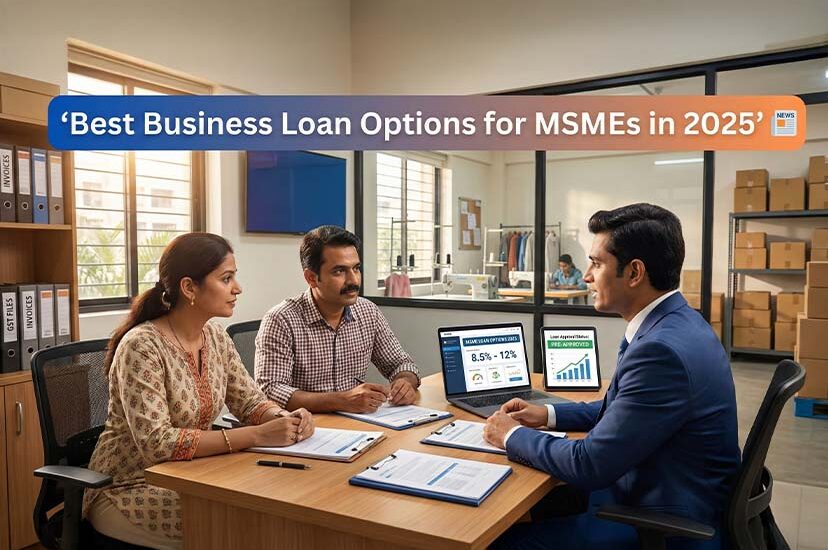
Micro, Small, and Medium Enterprises play a crucial role in the economic growth of India. The demand for quick and safe credits is evident in different sectors like manufacturing, retail, logistics, exports, and e-commerce. In 2025, the landscape of business loans has transformed completely, with an improved onboarding process, tailor-made repayment plans, and government-backed programs, which will significantly facilitate access to credit. This guide breaks down the best MSME business loans 2025, including private lending, government schemes, and innovations that support MSMEs to maintain cash flow and scale sustainably.
Understanding the Funding Needs of MSMEs in 2025
Most of the operational needs of MSMEs that may require urgent financial assistance include raw material procurement, improvement of infrastructure, hiring, technology adoption, and covering cash gaps. This is where the business loan options to MSMEs become indispensable. Lenders have shifted towards cash-based lending, digital verification, and a quicker approval process driven by fintech innovation.
Proper profiling based on bank statements, GST returns, and bureau data has enabled lenders to provide customized MSME financing options with enhanced transparency and less processing time.
Top Business Loan Options MSMEs Should Consider in 2025
The following are the most effective and accessible loan products available to MSMEs, tailored to their specific needs and financial profiles.
- Traditional Term Loans
Conventional term loans remain one of the most sought-after business loans for small businesses wishing to finance long-term growth. These loans give a lump sum that could be used for the purchase of equipment, factory upgrades, or the establishment of new business units.
Term loans usually come with structured EMIs and a fixed tenure. Although the lenders consider revenue trends and asset base, they also factor in MSME loan eligibility factors such as credit score, business stability, and repayment capacity.
- Working Capital Loans
Working capital is still the lifeline of MSME activities. In 2025, the working capital loans for MSMEs have increased due to banks as well as fintech lenders providing collateral-free credit lines. The loans aid the business in dealing with seasonal changes, late payment on the part of customers, and the gap in cash cycles.
With increased inflation rates and supply chain disruptions, a working capital support basis will ensure that the MSMEs are able to uphold production schedules and satisfy market needs at all times.
- Line of Credit Facilities
A line of credit is a flexible financing option where businesses can draw money at will within a pre-approved limit. This is because it would be suitable for addressing irregular cash flow patterns. Many fintechs in 2025 are providing an option of instant renewal and dynamic credit limit changes depending on new financial information.
These credit lines are considered modern MSME financing options that are aimed at businesses that prefer agility to lump-sum borrowing.
- Government-Backed MSME Loan Schemes
Government initiatives are still considered one of the most powerful drivers of MSME credit growth. The Government MSME loans 2025 portfolio includes schemes that have subsidized interest rates, no collateral, and simple approval procedures.
Key schemes include:
- CGTMSE (Credit Guarantee Fund Trust of micro and small enterprises) – collateral-free loans up to ₹2 crore.
- PMEGP (Prime Minister’s Employment Generating Programme) – manufacturing and service unit loans with a margin subsidy.
- Stand-Up India Scheme – Loans for women and SC/ST entrepreneurs.
- Mudra Loans– Shishu, Kishor and Tarun loans to various levels of business.
These MSME loan schemes suit best the new entrepreneurs, small manufacturers, and businesses that do not have physical collateral.
- Machinery and Equipment Financing
Demand for machinery loans has increased with India pushing to achieve excellence in manufacturing. The loans are used to assist the MSMEs in embracing automation, modernization of old equipment, and enhanced production.
The asset security means that MSME loans are competitively charged by lenders, though in most cases, partial collateral is required.
- Invoice Financing and Invoice Discounting
Invoice discounting has become an effective instrument for MSMEs that have lengthy credit periods. It enables companies to get future payment on their pending bills rather than waiting 30 to 90 days to get their payment.
Today, invoice discounting is available digitally, quickly, and conveniently, and because it is offered by fintech companies, it is a powerful option to traditional business loans, which are offered in 2025. It is specifically advantageous to exporters, logistics firms, and B2B suppliers.
Eligibility, Interest Rates, and Key Evaluation Factors
When MSME loans are being granted, lenders consider several parameters:
Eligibility Criteria
Key MSME loan eligibility criteria include–
- Minimum business vintage (1-3 years old, depending on lender)
- Regular bank statement transactions.
- Valid GST registration
- Clean repayment history
- Good credit score
Interest Rates and Charges
The interest rates on MSME loans charged on unsecured loans are between 10 and 18 per cent, and for secured loans, it is between 8-14 per cent. There are also charges that are made on processing and repayment penalties, as well as GST charged on loan services.
Documentation Requirements
Although digital lending has simplified documentation, the following are the main requirements:
- KYC documents
- GST returns
- ITR for the past 1-2 years
- Audited financial statements
- Outstanding debt details
Choosing the Right Loan Option for Your Business
Various financing products are suited to different business models. For example:
- High-volume trading businesses benefit from working capital loans for MSMEs.
- The manufacturing units can choose term loans or equipment leasing.
- Digital-first companies may lean towards fintech-based credit lines.
- Businesses that rely on cash flows favour invoice discounting.
An effective comparison would enable SMEs to choose the most effective and cost-efficient MSME financing model based on their objectives.
A Strategic Approach to Loan Planning in 2025
To maximize the benefits of any financing product, MSMEs should:
- Follow monthly cash flow patterns.
- Maintain strong GST and banking records.
- Improve credit discipline
- Compare interest rates before borrowing.
- Calculate EMI structures using loan calculators.
It is necessary to have smart financial planning to make sure that the business loan opportunity that MSMEs have access to encourages growth rather than imposes a financial burden.
Why Selecting the Right MSME Loan Matters in 2025
The selection of an appropriate business loan determines the growth and failure of an MSME. As lenders are offering more innovation, digitally onboarding, and custom products than ever, 2025 is a revolutionary year for MSMEs to access credit. Be it the decision to take up term loans, flexible credit lines, or the government-sponsored MSME loan schemes, it is up to the business to ensure that the financing applies to their operational needs, ability to pay, and long-term perspective.
Credlix enables MSMEs to have a smooth supply of invoice discounting and export finance products. We provide businesses with a working capital solution that enables them to operate effectively by unlocking fast working capital. It is done by unlocking unpaid invoices to avoid delays in cash flows and avoiding reliance on business loans alone. Credlix helps small businesses to grow without fear because of its quick onboarding and digital processes.
Frequently Asked Questions
Q1: What is the most suitable MSME loan for new small businesses in 2025?
Governmental schemes such as CGTMSE or Mudra Loans can help new MSMEs in most cases. Majorly because these do not require collateral and have favorable interest rates.
Q2: What factors affect loan approval for MSMEs?
The most important parameters of evaluation would be credit score, business vintage, stability of cash flow, GST compliance, and financial documentation.
Q3: Are digital lenders reliable for MSME loans in 2025?
Yes. RBI-regulated fintech lenders and digital NBFCs offer secure, fast, and transparent lending options with minimum paperwork, which makes them a great option compared to traditional banks.