
- March 17, 2026
- Posted by: Rishabh Agrawal
- Categories: Business Loans, Blog
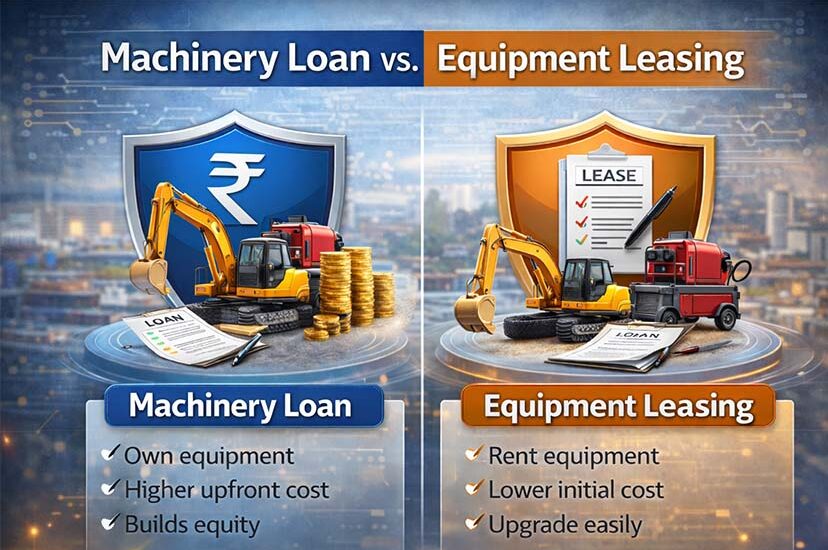
Modern machinery and specialized equipment are important in the manufacturing business to ensure businesses remain productive, enhance efficiency and competitiveness in the market. But buying industrial machines may need a huge amount of capital investment, and this may strain the cash flow, particularly among small and medium-sized manufacturers. In order to address this hurdle, companies usually consider means of financing whereby they can get equipment without having to finance the entire cost.
The machinery loans, as well as equipment leasing, are two of the most prevalent methods of financing that manufacturers can use. The two solutions enable companies to obtain critical equipment whilst using their working capital more efficiently. However, these financing models have varied structures regarding how they are owned, payment structure, tax implications, and financial impacts over the long run.
Understanding the distinction between the two financing methods, machinery loans and equipment leasing for manufacturers, can assist the business in determining the most appropriate method of financing according to the operational requirements and approach to financing.
What is a Machinery Loan?
A machinery loan is a business financing that enables organizations to acquire industrial machinery or equipment through borrowing money from a bank or other financial institution. The loan is paid back to the lender in installments and after all the borrowed sum is repaid, the business is the full owner of the machinery.
Understanding Machinery Loans for Manufacturing Businesses
A manufacturing loan is taken by a business to acquire necessary machinery used in manufacturing, like production machines, assembly systems, packaging equipment or processing units. The company does not pay the entire amount, but instead, it finances the purchase via a procedural repayment scheme.
The loan is generally secured against the machinery itself. It implies that the lenders can repossess the equipment in case of default by the borrower to pay the loan. Machinery loans are an opportunity for many manufacturers where they can invest in productivity-enhancing equipment and spread the expense over several years.
The other benefit of industrial machinery financing is that once the loan is repaid, businesses become the owners of the equipment. This enables the companies to use the machinery as a long-term asset in their production process.
What is Equipment Leasing?
Equipment leasing is a type of financing whereby a firm rents machinery or equipment from a leasing company for a certain period. The business will not have to buy the equipment at once; it will make regular lease payments as it continues using the equipment to conduct its operations.
How Equipment Leasing Works for Manufacturers
In an equipment leasing agreement, the equipment is not owned by the party leasing the equipment since the machinery remains the property of the leasing company, and the manufacturer pays regular lease fees to the leasing company to use the equipment. This system enables businesses to have access to high-quality equipment without necessarily making a huge investment in it.
The manufacturer can have various alternatives at the expiry of the lease period based on the terms of the contract. Certain contracts enable the enterprise to buy the equipment at a discounted cost, renew the lease, or send back the equipment to the leaseholding enterprise.
In manufacturing companies with a high rate of updating technology in production, equipment leasing for manufacturers may offer flexibility and permit them to acquire more modern machinery without huge capital investments.
Key Differences Between Machinery Loans and Equipment Leasing
The decision to use machinery loans or equipment leasing is determined by many financial and operational considerations. These two financing options have significant differences that are shown in the table below.
| Factor | Machinery Loan | Equipment Leasing |
| Ownership | The business owns the machinery after repayment | The leasing company owns the equipment |
| Upfront cost | May require a down payment | Usually lower upfront cost |
| Payment Structure | Loan EMIs | Lease payments |
| Asset Classification | Treated as a company asset | Considered an operating expense |
| Equipment upgrades | Difficult to replace before loan completion | Easier to upgrade after the lease term |
These differences can assist manufacturers in considering which equipment financing options will be better aligned with their business objectives.
Advantages of Machinery Loans for Manufacturers
A machinery loan for manufacturing businesses provides several benefits to a company that is intending to make long-term investments in production.
First, the machinery eventually gets into the hands of the business in full ownership. The equipment is a long-term production asset that can last many years once the loan is repaid.
Second, ownership enables the manufacturers to tailor or alter the equipment to suit working needs. This flexibility is normally significant in organizations that have specialized manufacturing procedures.
The other advantage is that machinery financing through loans might have tax benefits, as businesses can depreciate the assets they own. This will assist in the decimation of the total tax load on manufacturing enterprises.
Benefits of Equipment Leasing for Industrial Businesses
The equipment leasing for industrial machinery has a different set of benefits, especially when it comes to companies that prefer to save capital and have the ability to be operationally flexible.
Leasing does not require as high an initial investment as loans, by which equipment is purchased. This helps the manufacturers to save money in other operational requirements like inventory, labor or growth.
Technological flexibility is another advantage. Leasing is also used in sectors where machinery may become obsolete soon, and the business is therefore able to change equipment more often without the desire of owning them.
Also, lease payments can be classified as operating expenses, and this could make the accounting and financial planning easier for some companies.
When Should Manufacturers Choose a Machinery Loan?
Machinery loan is applicable to those businesses intending to utilize equipment over a long duration and desire to develop asset holdings in their organization.
Loan financing is usually preferred by manufacturers who invest in heavy industrial equipment, production lines, or specialized equipment, as it is used over a long period of time. Ownership will also enable the companies to create long-term value from the equipment.
This could be attractive to companies whose revenue streams are stable and financial plans are strong, since the companies can pay the cost over time as they increase production capacity.
When Equipment Leasing May Be a Better Option
In some cases, equipment leasing can be better applied to manufacturers that operate within fast-changing industries where technology changes more often.
As an example, companies which operate on a high level of automation systems or specialized production technology might have to replace machinery frequently. Leasing will enable them to upgrade equipment at the expiry of the lease period without incurring major financial loss.
Leasing may be a good option too in cases where the small manufacturers would like to begin production soon, but do not want to invest huge sums of money as initial capital.
Choosing the Right Equipment Financing Strategy for Manufacturers
The choice of machinery financing options for manufacturers has a number of factors based on the financial capacity, production needs, and future growth strategy of the company.
Machinery ownership through loans is potentially beneficial to businesses that intend to produce constantly over a long period. Conversely, leasing may suit companies that are flexible and do not need to invest a lot.
Manufacturers can select one of the most effective equipment financing strategies by carefully assessing the overall cost of financing, operational needs, and future equipment needs.
How Credlix Supports Manufacturers with Flexible Financing Solutions
Availability of finances in a timely manner is important in assisting manufacturers to grow their business and invest in new machinery. Credlix offers an innovative financial service that is aimed at serving companies operating with massive production cycles and supply chains.
Credlix provides manufacturers with the flexibility of trade finance and working capital solutions so that they can keep the cash flowing whilst investing in machinery, equipment, and production capacity. It allows companies to operate effectively by releasing money that is tied down in receivables to run the business operations.
Frequently Asked Questions
- What is the difference between a machinery loan and equipment leasing?
In machinery loan, a business can borrow to buy equipment and acquire it on repayment. Equipment leasing offers the company an opportunity to utilize equipment by paying lease payments as the equipment remains in the ownership of the leasing company.
- Which financing option is more suitable for manufacturers?
The decision is based on the business requirements. Machinery loans are suitable when the equipment is to be owned over a long period, whereas equipment leasing is flexible and less expensive to the business that requires continuous modernization of technology.
- Are small manufacturers entitled to apply for machinery financing?
Yes. Most of the banks and other financial institutions have machine loans and equipment leasing opportunities for the MSMEs and small manufacturers. These sources of finance are useful in enabling businesses to obtain production equipments at the same time efficiently managing their working capital
