
- March 19, 2026
- Posted by: Rishabh Agrawal
- Categories: Business Fundamentals, Blog
An efficient supply chain network is required to ensure that products move effectively between manufacturers and final consumers. The distributors and dealers play a significant role in this network in facilitating the flow of products, extending their market reach, and also ensuring that products are available in the various regions. Although both entities assist manufacturers in supplying goods to the market, their roles, relationships with manufacturers, and operational functions differ greatly.
Knowledge of the difference between distributors and dealers is significant for businesses developing an efficient supply chain channel. The two have important roles in the movement of products from manufacturers to the market, but their functions, scope of operation, and the relationship with the suppliers differ. An understanding of such differences aids firms in designing distribution networks in a better way, enhancing market accessibility.
Who is a Dealer and who is a Distributor?
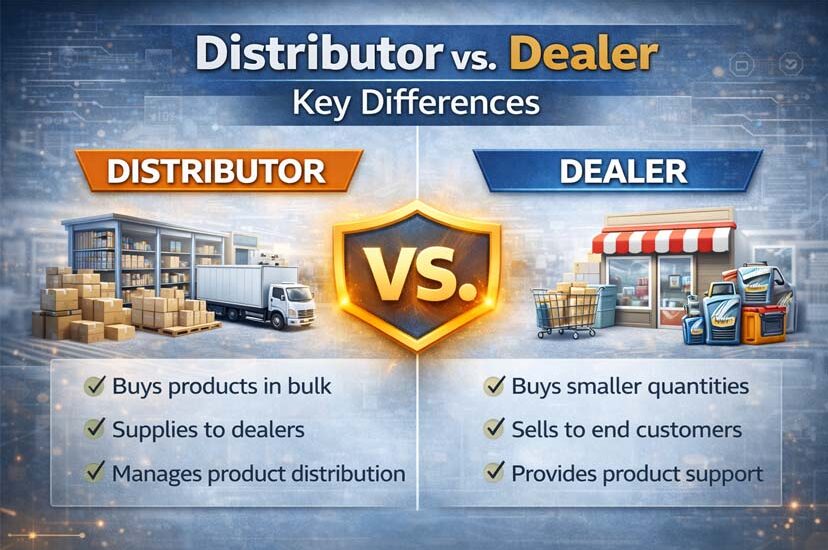
A distributor provides a middle ground between manufacturers and dealers or retailers, where he buys goods in large quantities and sell them to different markets. On the other hand, a dealer is someone who purchases products from distributors or manufacturers and resells them or sells to customers or retailers in a particular territory.
Distributors’ Role In The Supply Chain
Distributors are a major connection between the manufacturers and the wider market. They usually buy in bulk and also make sure that the products they buy are delivered to dealers, retailers, or regional markets in an effective way.
The key roles of a distributor are:
- Buying in large quantities from the manufacturers.
- Dealing with the storage and inventory of the products.
- Distributing the products to the dealers or the retailers.
- Increased coverage of markets in geographic areas.
- Favouring marketing and product promotion.
Distributors tend to be more significant in the establishment of a robust distribution network by manufacturers since they work on a larger scale.
Role of a Dealer in the Supply Chain
Dealers are closer to the end customer in the supply chain. Their primary role is to sell products to people or companies that are located in a specific market.
Key responsibilities of a dealer include:
- Buying products directly from distributors or manufacturers.
- The direct selling to customers or retailers.
- Delivering customer service and product information.
- Local sales and market relationship management.
- Ensuring product supplies in retail stores.
Dealers also facilitate the manufacturers to reach the customers effectively, making the products available in the local market.
Key Differences Between a Distributor and a Dealer
Despite the fact that the role of distributors and dealers is similar, as they both are involved in product distribution, their functions vary in a number of aspects.
| Factor | Distributor | Dealer |
| Position in the supply chain | Operates between the manufacturer and the dealer | Operates between the distributor and the customer |
| Purchase volume | Buys products in large quantities | Purchases smaller quantities |
| Market coverage | Often handles regional or national distribution | Focuses on a specific territory or local market |
| Primary function | Product distribution and logistics management | Direct product sales |
| Relationship with manufacturer | Often works closely with the manufacturer | Usually interacts with distributors |
This difference will enable companies to define roles in their supply chain network.
How Distributors and Dealers Work Together
The dealers and distributors may work in a coordinated system that makes sure that products flow smoothly out of production units to the consumers.
A common trend of distribution can be such:
Manufacturer → Distributor → Dealer → Customer
In this model:
- Manufacturers focus on production.
- Distributors deal with bulk distribution logistics and the market.
- The dealers are set at direct sales and customer interaction.
This is a systematic strategy that enables businesses to expand their operation without losing market penetration.
Importance of Distributors and Dealers in Supply Chains
Distributors and dealers are also crucial to the provision of a robust supply chain. Their cooperation has contributed to the growth of the manufacturers in new markets while also maintaining the availability of the products.
Key benefits of a strong distributor–dealer network include:
- Shortened time for delivering products to different areas.
- Better penetration in the market.
- Improved inventory management.
- Increased accessibility for customers.
More effective and stable supply chains can be developed by companies that develop the proper relations between distributors and dealers.
Choosing the Right Distribution Strategy
The manufacturers must carefully design their distribution strategies, depending on the type of product and market size, and their business objectives.
Some companies are more likely to work with the large distributors to expand into multiple markets, whereas others can be dependent on the direct dealer networks to increase local sales.
The influencing factors that affect distribution strategy are:
- Market size and demand for the product.
- Logistics capabilities
- Marketing outlets and access to customers.
- Inventory management requirements.
The knowledge about distributor vs dealer structure enables the business to develop a distribution system that facilitates long-term growth.
Significant Revelations about Distributor and Dealer Position in Supply Chain
The role of distributors and dealers in linking the manufacturers with the final consumers is critical. Whereas distributors are interested in bulk buying and distribution of products in large quantities, dealers are interested in direct sales in local markets. It is important to know the key difference between distributors and dealers so that businesses develop effective supply chains and enhance market penetration.
A well-organized distribution system facilitates better flow of products, inventory, and accessibility of goods to customers. Firms that specify the roles of distributors and dealers will be able to establish better partnerships and maximize their performance in the supply chain.
Credlix Trade Finance Solutions for Supply Chain
Businesses operating in distribution channels are usually characterized by working capital issues in managing inventory purchases, the cost of logistics, and sales cycles. Credlix offers trade finance services to assist companies in accessing funds to use against invoices to enhance their liquidity and facilitate business activities.
The distributors, dealers, and manufacturers have better access to working capital and are able to manage supply chains efficiently and increase their market coverage.
Frequently Asked Questions
- What is the difference between a distributor and a dealer?
A distributor buys products in large quantities from manufacturers and sells them to dealers or retailers. A dealer buys products from distributors and markets them directly to customers in a given market.
- Can a company work directly with dealers instead of distributors?
Yes. Some companies choose to work directly with dealers–particularly when they are dealing with small markets or when they desire to have greater control of local sales activities.
- Why are distributors important in the supply chain?
The distributors assist the manufacturers to increase their market penetration through bulk purchasing, logistics and local distribution of products so that they are accessible to dealers and retailers effectively.
