
- March 20, 2026
- Posted by: Rishabh Agrawal
- Categories: Food and Agriculture, Blog
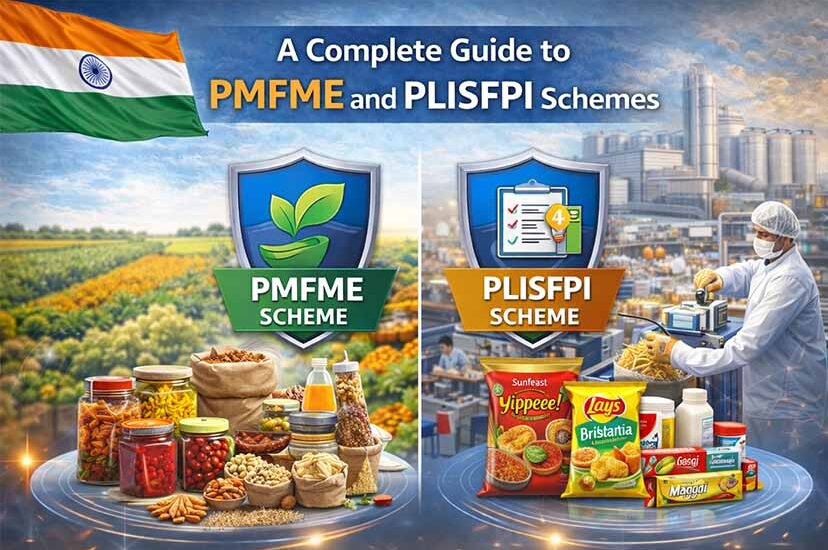
The food processing industry is a crucial part of the Indian economy that reinforces agricultural value chains, job creation, and enhances export possibilities. However, a significant number of small food businesses face challenges in accessing capital, as well as technology and modern processing facilities. To overcome these difficulties, the government has introduced special assistance programs that seek to empower the micro and small food companies.
Two key programs to assist in this sector are the PMFME scheme and the PLISFPI scheme. These programs are designed to enhance the use of technology, the level of food processing and promote organized growth of small food establishments. To MSMEs in the food processing sector, knowing how such schemes can be effective is useful to unlock funds to be used in production, expansion of production capacity, and competitiveness in local and international markets.
This guide explains the structure, benefits, and requirements of both schemes and how food processing MSMEs can benefit from them.
What are PMFME and PLISFPI Schemes?
Government programs developed to reinforce the food processing ecosystem in India are the Pradhan Mantri Formalisation of Micro Food Processing Enterprises scheme and the Production Linked Incentive Scheme of Food Processing Industry. These programs offer monetary benefits, infrastructural assistance, and growth opportunities to the food processing MSMEs, which promote modernization, growth, and value addition to the industry.
Understanding the PMFME Scheme
The PMFME scheme was initiated to assist micro-level food processing companies by supporting them in their transition from informal operations to formal enterprises. There are several small food units which are not registered, branded or even financially supported. This plan will help in bridging these gaps.
Micro food processing enterprises are helped in upgrading technology, improving product quality, better packaging and branding under the PMFME program. The program is also based on the construction of resilient supply networks and ensuring an increase in access to markets by small food businesses.
The scheme encourages the One District One Product (ODOP) strategy, whereby districts specialize in a specific food item depending on the local agricultural advantages. The strategy assists in creating regional food clusters and enhancing the promotion of local products within the national and international markets.
Key Features of the PMFME Scheme
The PMFME scheme for food processing MSMEs is a source of support in a variety of forms, which are intended to empower small businesses.
| Feature | Description |
| Credit-linked subsidy | Financial assistance for upgrading food processing units |
| Capacity building | Training programs for entrepreneurs |
| Branding and marketing support | Assistance for product branding and packaging |
| Cluster-based development | Support through ODOP initiatives |
| Formalization assistance | Help with business registration and compliance |
The PMFME scheme, through these efforts, aids the micro food enterprises to increase their productivity and shift towards organized business operations.
The PMFME Eligibility Criteria
Food processing businesses must meet certain conditions to benefit from the PMFME scheme for MSMEs.
| Criteria | Details |
| Business type | Micro food processing enterprises |
| Ownership | Individual entrepreneurs, SHGs, or cooperatives |
| Business activity | Processing, value addition, or packaging of food products |
| Location | Rural or semi-urban areas across India |
| Registration | Basic documentation and business identification |
These conditions guarantee that the scheme is helpful to those businesses that are operating at the bottom level of the food processing industry.
Understanding the PLISFPI Scheme
The PLISFPI scheme aims at enhancing high investment and innovation in the food processing sector. This scheme is contrary to PMFME, which focuses on micro enterprises, as it encourages companies to increase the volume of production and introduce new advanced processing technologies.
Production Linked Incentive Scheme for the Food Processing Industry entails incentives in the form of financial rewards, which are dependent on incremental sales of processed food products. The strategy will promote expansion by the companies, efficiency and global competitiveness in the food brands.
The scheme also seeks to enhance the position in the world food markets by promoting value-added food production and exporting.
Key Components of the PLISFPI Scheme
The PLISFPI scheme for the food processing company has a number of incentives that aim at driving growth in the industry.
| Components | Description |
| Sales-based incentives | Financial rewards linked to incremental sales |
| Support for branding | Assistance for developing global food brands |
| Expansion incentives | Encouragement for capacity expansion |
| Innovation support | Incentives for new product development |
The PLISFPI scheme also encourages companies to invest in up-to-date processing facilities by offering incentives based on performance.
PLISFPI Eligibility Criteria
To obtain the PLISFPI scheme, companies should fulfil some requirements in investments and operations.
| Criteria | Details |
| Business Type | Food processing companies |
| Investment commitment | Minimum investment thresholds |
| Product categories | Eligible processed food products |
| Sales performance | Incremental sales growth is required |
| Compliance | Adherence to government regulations |
These requirements mean that incentives are to be given to those businesses capable of playing a significant role in the development of the food processing industry.
PMFME vs PLISFPI: Key Differences
Even though the food processing industry is supported by both of these programs, there is a difference in their purpose and target groups.
| Aspect | PMFME Scheme | PLISFPI Scheme |
| Target Businesses | Micro food enterprises | Medium and large food companies |
| Focus | Formalization and small business support | Large-scale production growth |
| Incentive Type | Subsidies and training | Sales-linked financial incentives |
| Primary Objective | Strengthen grassroots food processing | Boost exports and large-scale investments |
The knowledge of these differences assists the entrepreneurs in deciding the food processing government scheme that best fits the business requirements.
Key Insights on PMFME and PLISFPI Schemes for Food Processing MSMEs
The government support programs are useful in boosting the food processing industry in India. The PMFME scheme is aimed at assisting micro food businesses in formalizing their work and enhancing the quality of products, whereas the PLISFPI scheme stimulates large investments and increases production. Knowing the goals and advantages of these projects, food processing MSMEs will have opportunities to receive financial support, use modern technologies, and become more popular in domestic and international markets. Such plans eventually lead to a stronger and more competitive food processing industry in India.
Credlix Supporting Food Processing MSMEs with Trade Finance Solutions
The working capital is usually a problem for food processing MSMEs when dealing with procurement, production and export orders. Credlix is a trade finance company which provides businesses with access to funds in exchange for invoices so that businesses can maintain liquidity and operate supply chains effectively as their businesses grow and process more food.
Frequently Asked Questions
- What is the PMFME scheme?
The PMFME scheme is a government program that is aimed at assisting micro food processing firms by giving them subsidies based on credit, training and marketing assistance. It assists small food enterprises in streamlining operations and enhancing product quality.
- What is the PLISFPI scheme?
The PLISFPI scheme offers financial incentives to food processing enterprises in terms of growth of incremental sales. It promotes the allocation of funds to advanced processing plants, product innovation, and the creation of globally competitive food brands.
- Who can benefit from the PMFME and PLISFPI schemes?
These schemes can be availed by micro food processing enterprises, entrepreneurs, cooperatives, and food processing companies. Whereas PMFME targets the small businesses, PLISFPI targets mainly larger businesses in terms of investments in the expansion of production and export development.
