
- April 27, 2026
- Posted by: Rishabh Agrawal
- Categories: Export Financing, Blog
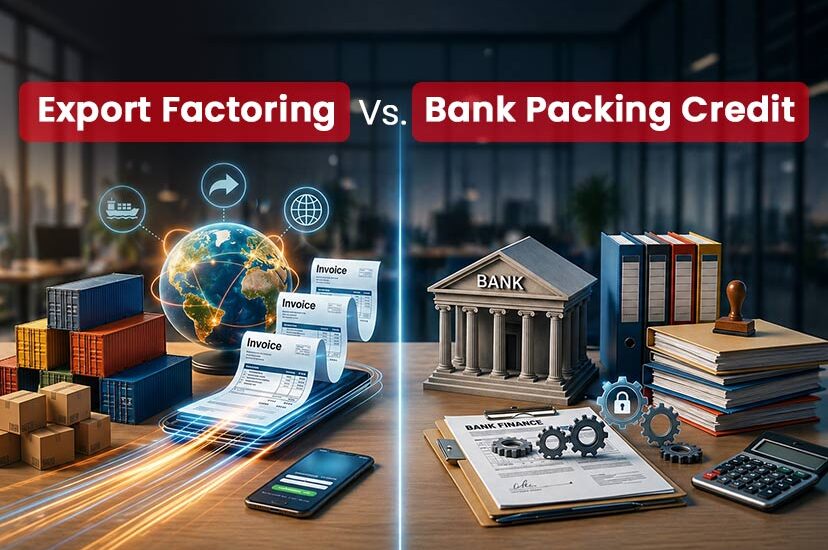
One of the largest challenges in international trade management among Indian MSME exporters is the maintenance of working capital. The export orders also have the potential to provide growth opportunities; however, delayed payments by overseas purchasers can impose severe strain on cash flow. Simultaneously, companies require finances to purchase raw resources, manufacture products, manage packaging, and pay shipping costs before export payments are made.
To bridge this funding gap, exporters depend on external funding solutions. Export factoring and bank packing credit are two of the most popular options. Both are aimed at enhancing liquidity, but the processes they operate differ, and they are used in different phases of the export cycle. One assists businesses in getting funds based on unpaid invoices against shipment, whereas the other assists in production and operating costs by offering pre-shipment finance.
The decision to use export factoring vs bank packing credit is not only about a quick cash inflow but also about understanding the total cost, flexibility, approval procedures, collateral and its long-term effect on the cash flow of the business. The appropriate option can assist exporters in decreasing monetary strain and expanding worldwide operations with assurance.
What Is Export Factoring?
Export factoring is a post-shipment financing method where the exporters sell their outstanding invoices to a factoring firm in exchange for working capital. The factor provides a big percentage advance of the invoice value after the shipment of the goods and raising the invoice.
The factoring firm then collects the money directly from the overseas buyer on the due date. Depending on the agreement, factoring may include buyer credit checks, payment protection, and international collections support. Export invoice factoring is more beneficial to companies with long credit cycles than waiting 30, 60 or 90 days to receive the payment.
What Is Bank Packing Credit?
Bank packing credit is a pre-shipment working capital loan by banks to exporters. It is used in financing the purchases of raw materials, labor expenses, production, processing, packaging and transportation before goods are exported.
Such finance is usually approved on the basis of confirmed export orders, letters of credit or export contracts. The packing credit loan is repaid once the export proceeds are received after the shipment has been made. Packaging credit for exporters is usually among the most popular traditional finance facilities for exporters who want to get low-cost pre-shipment financing.
Understanding the Core Difference Between the Two Financing Options
The primary distinction between the export factoring of MSMEs and bank packing credit in India lies in the financing stage and services included.
| Basis | Export Factoring | Bank Packing Credit |
| Financing Stage | Post-shipment | Pre-shipment |
| Based On | Unpaid invoices | Export orders/contracts |
| Collections Support | Included in most cases | Not included |
| Credit Protection | Available in some cases | Usually not available |
| Repayment Source | Buyer payment | Export proceeds |
| Collateral Requirement | Often low or none | May require collateral |
The difference is important because the exporters may require money at various points in the business cycle.
Cost Structure of Export Factoring
Factoring may seem to be costlier than conventional bank funding at first. Nevertheless, the price is usually accompanied by several value-added services. The overall cost of export factoring can include:
- The factoring fee is charged as a percentage of the invoice value.
- Interest on or discounting according to the time of advance.
- Collection or service charges in some cases.
- Buyer credit insurance or payment protection fee, where applicable.
For instance, when an exporter raises an invoice of 10 lakh rupees and gets an 80 per cent advance, the factoring company can take away some money depending on the payment duration and services utilized. The direct expense might be greater, but exporters save time and operational expenses with outsourced collections and less risk of payment.
Cost Structure of Bank Packing Credit
Bank packing credit is typically lower than factoring because it operates as a traditional working capital loan.
Common charges include:
- Interest on the amount sanctioned.
- Handling or recording charges.
- Renewal or maintenance fee.
- Collateral-related legal or valuation charges, if applicable.
Under the export promotion schemes, banks can provide preferential interest rates and hence packing credit costs of businesses with a good financial profile are reduced. Exporters, however, have to handle the collections separately and also face the risk of late or non-payment of invoices.
Hidden Costs Businesses Often Ignore
When comparing costs, most MSMEs consider interest rates and neglect the indirect costs.
In the case of bank packing credit, the concealed expenses can be:
- Late approval of production schedules.
- Blocked collateral opportunity cost.
- Collection expenditures.
- Buyer losses due to default or late payments.
In the case of export factoring, there may be:
- Increased charges on high-risk consumers.
- Fees for extra protection services.
- Deductions in case of disputed invoices.
A proper cost comparison should include both visible and hidden financial impacts.
Which Financing Option Costs Less in Real Business Scenarios?
There is no one-size-fits-all solution, but bank packing credit may cost less if a business has-
- Strong collateral
- A strong banking relationship.
- short payment cycles by buyers.
- Low collection risk
However, in case a business experiences:
- Long overseas payment periods.
- Buyer credit risks
- Urgent working capital requirements.
- Limited collateral
Then, export factoring of MSME exporters can be a better value at a higher initial cost.
Approval Process and Accessibility for MSMEs
Export factoring can be easier and quicker to process since approval is obtained mostly based on:
- Invoice quality
- Buyer credibility
- Trade transaction history
It has made it affordable to smaller exporters who might not be eligible to take big bank loans.
Bank packing credit will frequently demand:
- Detailed financial statements
- Export order verification
- Collateral assessment
- Longer approval timelines
Factoring is much quicker to obtain in case of emergency funding.
Impact on Cash Flow and Business Operations
The impact on the cash flow is significantly different in both cases.
- Under export factoring services, exporters get instant liquidity upon shipment. This assists in maintaining the working capital in case of long payment cycles and enables the business to proceed smoothly.
- In the case of a packing credit loan, a business receives loans before shipment, but the repayment will be made when the export proceeds are obtained on time.
Failures in payments by buyers might put pressure on the exporter for repayment. This can cause cash flow pressure to businesses that are working on thin margins.
Risk and Payment Protection Comparison
Another consideration is risk management. Factoring includes:
- Buyer credit assessment
- Payment collection support
- Bad debt protection in non-recourse agreements
This lowers the uncertainties in global trade. Packing credit is not usually a source of such protection. The exporter will also handle the default risk and collect payment. It renders export factoring in India more appealing to venturing businesses.
Choosing the Right Financing Strategy for Your Business
The correct decision lies within the business requirements. Select bank packing credit when:
- Pre-shipment finance is required.
- You have good banking relationships.
- The priority is cost minimization.
- Low buyer payment risk.
Select export factoring when:
- You require liquidity after shipment.
- Long payment cycles.
- Buyer risk is high
- It is essential to get money within a shorter time.
Strategic combinations are often employed by many exporters to maximize working capital throughout the export cycle.
Building a Cost-Efficient Export Financing Strategy
The interest rates should not be the sole factor that MEME exporters should use when choosing between export factoring vs bank packing credit. The overall value depends on timing, flexibility, risk cover, and efficiency in operation.
Although packing credit can lead to lower direct borrowing rates–export factoring can alleviate collection pressures and enhance predictability in cash flows. Businesses can make smarter financing decisions and maintain stronger financial stability in global trade by evaluating the visible and the hidden costs.
Unlock Faster Export Liquidity with Credlix
The long payment cycles may slow down the growth of exports and cause undue cash flow strain. Credlix assists MSME exporters to unlock working capital on unpaid invoices within a short time without having to wait till the overseas buyers make payments.
Credlix has been a trusted platform for exporters to enhance their liquidity, alleviate financial strain and expand operations across international borders more effectively with fast processing, flexible trade finance solutions and invoice-based funding.
FAQs–
- Is the export factoring less expensive than the bank packing credit?
Direct interest costs on bank packing credit can be lower, but export factoring can be more advantageous in general by providing quicker access to funds and security of payment.
- Is it possible to have factoring and packing credit on the part of exporters?
Yes. Most exporters operate on packing credit to cover the pre-shipment expenses and factoring as a post-shipment working capital.
- Does export factoring require collateral?
Export factoring, in most instances, will not need much or any collateral since they are also financed on invoice quality and buyer credibility.
