
- July 14, 2026
- Posted by: Rishabh Agrawal
- Categories: HTS Code, Blog
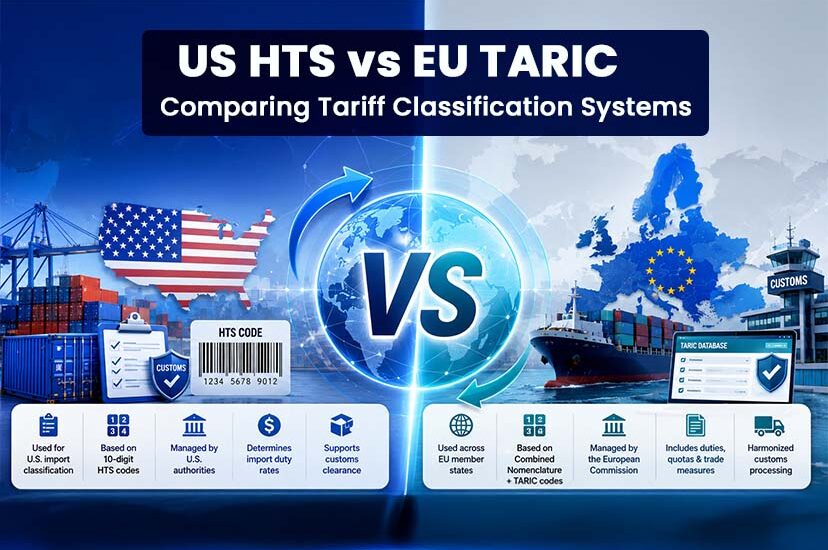
International trade has become increasingly interconnected as businesses rely on multiple countries for raw materials and product sales. There is no denying the fact that exploring global markets is currently an exciting avenue. However, it is also tricky to navigate due to differing customs regulations in each region. The first and most significant part of cross-border trade is choosing the right tariff classification system. Even minor errors can lead to misclassified duties or compliance issues.
It is crucial to have knowledge about the discrepancies between the US HTS vs EU TARIC for companies involved in cross-border trade with the EU and the United States. They are two different systems based on the internationally accepted Harmonized System and are both subject to different regulatory and customs systems. Understanding how the system functions can help importers and exporters determine the correct duties, comply with them, and simplify international trade processes.
Explaining the US Harmonized Tariff Schedule
The Harmonized Tariff Schedule is the official classification system for goods imported into the United States to classify and determine the applicable customs duties. The HTS is administered by the US International Trade Commission and uses a ten-digit classification code derived from the Harmonized System. It is the primary guide to classification and customs duty determination. The tariff schedule is also used for trade reporting in the United States.
Understanding the EU TARIC System
The EU Integrated Tariff of the European Union is a single database that brings together tariff classifications and further trade measures. TARIC is handled by the European Commission and includes regulations on customs duties and tariff quotas. Anti-dumping duties and import restrictions are some other regulations where it is imposed. It gives businesses a common ground for compliance in international trade in all the EU Member States.
Why Accurate Tariff Classification Matters in Global Trade
Choosing the correct tariff code is much more than determining the duty payable on imported goods. From customs clearance and regulatory compliance to trade agreements and import prices, it affects everything. Properly classifying goods can help avoid delays or customs disputes.
Accurate classification also ensures smooth operation and efficiency. Businesses can determine the exact amount of tax to be paid and prepare the necessary shipping documents to ensure compliance with customs regulations, with accurate customs duty calculation. This can also help companies prevent any unexpected customs charges, which may impact product pricing and profitability. Accurately determining tariff classification helps international companies conduct trade more efficiently and maintain better compliance measures.
US HTS vs EU TARIC: A Side-by-Side Comparison
| Feature | US HTS | EU TARIC |
| Governing Authority | US International Trade Commission | European Commission |
| Geographic Scope | United States | All European Union member states |
| Classification Structure | 10-digit HTS code | HS-based TARIC code with additional EU measures |
| Primary Purpose | Import tariff classification and duty assessment | Customs duties plus integrated regulatory measures |
| Trade Measures | Duties, trade preferences, import rules | Duties, quotas, anti-dumping duties, licenses, safeguards |
| Updates | Updated periodically by the US authorities | Updated regularly to reflect EU customs regulations |
| Main Users | US importers, customs brokers, exporters | EU importers, exporters, customs authorities, trade professionals |
Key Differences Between HTS and TARIC
- Classification Structure and Code Format
Both systems are based on the widely used Harmonized System, but with differences in how product codes are extended beyond the global standard. The HS code classification provides the first 6 digits, with the United States and the European Union applying their own coding system to comply with their domestic customs requirements.
- Scope of Customs Duties
The main responsibility of the US HTS is to classify items and apply import duties. Unlike EU TARIF, the EU TARIC covers a broader and more complete set of customs measures that impact product imports across Europe.
- Integration of Trade Measures
One of the most significant differences is the level of regulatory integration. TARIC consolidates customs duties, tariff quotas, anti-dumping duties, import licenses, and agricultural and safeguard measures. All these regulatory elements are not combined in a single system as they are in the Harmonized Tariff Schedule.
- Regulatory Coverage
The tariff classification is just one of several compliance issues that businesses importing into the European Union may need to take into account. Consequently, global trade regulations are being more widely captured in TARIC, whereas the US HTS is more concerned with customs classification and duty determination.
- Update Mechanisms
International trade laws are continually changing as new laws and trade agreements come into effect. Businesses must check customs tariff codes with continuously regulated updates before each shipment to help avoid any breaches and to accurately calculate duty.
Best Ways for Accurate Tariff Classification
Businesses can increase accuracy in classification and reduce compliance risks by implementing a few simple steps.
- Businesses should maintain detailed product descriptions. The composition and purpose of the product need to be comprehensive.
- Check the tariff classification before each shipment rather than depending on codes assigned in the past.
- Classify technically complex products with the help of customs experts.
- Strategically leverage digital trade management tools for accurate documentation and compliance.
Building a Stronger Foundation for Global Trade
There is an increasing need to know the difference between the US HTS and the EU TARIC with changing international trade regulations. Proper tariff classification is crucial for regulatory compliance, cost estimation, reducing customs delays, and informed supply chain decisions.
Businesses that can integrate effective trade compliance strategies with optimized financing solutions will be better positioned for success with a firm foundation for sustainable growth in a highly competitive global market.
How Credlix Helps Businesses Simplify Cross-Border Trade Finance
Accurately classifying goods for import and export is not enough for successful international trade; healthy cash flow throughout the import or export process is also essential. Credlix‘s technology-based trade finance solutions empower businesses to address working capital challenges in today’s global supply chain.
Whether it’s helping exporters secure faster working capital or facilitating seamless transactions between countries, Credlix can help businesses enhance their liquidity without any hassle. Digital and clear financing with extensive knowledge of trade helps companies concentrate on the growth of international markets without compromising the management of international trade.
FAQs
What is the major distinction between the US HTS and the EU TARIC?
Although they are both Harmonized System-based, they serve different purposes. In the United States, the main classification of goods for importation and calculation of customs duties is done using the US Harmonized Tariff Schedule. EU TARIC adds tariff quotas, anti-dumping policies, import licenses, and other trade policies for all the member states of the European Union.
Do businesses trading internationally need to use both HTS and TARIC?
It is important for businesses that are importing into or exporting to both the United States and the European Union to be familiar with tariff classification systems. Accurate duty calculations and smooth customs clearance, along with compliance with local regulations and minimizing shipment delays, penalties, or documentation errors in international trade, are all made possible with the use of the correct customs tariff codes.
What are the ways for businesses to ensure accurate tariff classification?
Businesses need to have detailed product specifications. Enterprises should regularly check the HTS and TARIC and use customs professionals when necessary. Combining accurate documentation with strong international trade compliance practices helps minimize classification errors and improve customs clearance efficiency.
