
- August 13, 2026
- Posted by: Rishabh Agrawal
- Categories: Goods and Services Tax, Blog
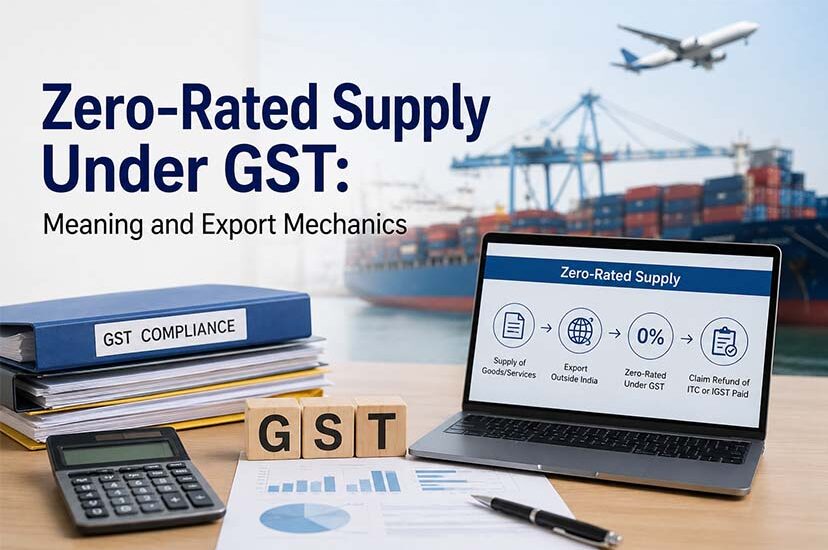
Exports play an important role in India’s international trade ecosystem, and GST provides specific solutions for eligible export transactions to prevent domestic taxes from becoming a cost for exporters. Zero-Rated Supply Under GST is therefore an important concept for businesses involved in exporting goods or supplying goods and services to eligible SEZ units and developers.
Understanding zero-rated treatment is important beyond GST reporting. This can also affect input tax credit, refund claims, documentation, and working capital planning. Exporters must distinguish zero-rated supplies from exempt supplies and follow the applicable procedures for claiming benefits under the GST framework.
What Is Zero-Rated Supply Under GST?
Under Section 16 of the Integrated Goods and Services Tax Act, 2017, zero-rated supplies include exports of goods or services and supplies of goods or services to an SEZ unit or developer for authorised operations.
The significance of zero-rated supply lies in the fact that eligible supplies can receive zero-rated treatment while input tax credit can remain available. This differs from simply treating the transaction as an exempt supply. For exporters, this distinction can directly affect how input taxes and eligible refund claims are handled.
Zero-Rated Supply vs Exempt Supply
Understanding the difference between zero-rated supply and an exempt supply is essential for GST compliance. Although both transactions may result in the same output-tax liability as a standard taxable domestic supply, their input tax treatment is different.
| Factor | Zero-Rated Supply | Exempt Supply |
| Output GST | Zero-rated treatment | Exempt from GST |
| Input Tax Credit | Available subject to applicable provisions | Generally restricted, subject to applicable rules |
| Exports | Covered under specified conditions | Not treated as exempt merely because they are exported |
| Refund Mechanism | Refund may be available subject to conditions | Different refund treatment applies |
| Main Provision | Section 16, IGST Act | Relevant exemption provisions |
The distinction matters because exporters may be eligible to claim refunds associated with zero-rated transactions when the applicable requirements are fulfilled.
What Qualifies as a Zero-Rated Supply
GST zero-rated exports broadly cover exports of goods and services. It also covers qualifying supplies made to SEZ units or developers for authorised operations. Businesses must satisfy the relevant statutory requirements before treating a transaction as an eligible zero-rated supply.
Export of Goods
An export of goods under GST involves taking goods from India to overseas. The transaction must satisfy the applicable definition and GST requirements.
Exporters should maintain appropriate shipping and tax documentation to establish the nature of the transaction and support their GST reporting and refund claims.
Export of Services
Export of services under GST involves several conditions. The supplier must be located in India under the IGST Act. The recipient must be located outside India, and the place of supply must be outside India. Payment must also be received in convertible foreign exchange or Indian rupees wherever permitted by the Reserve Bank of India. The supplier and recipient must not be merely establishments of the same distinct person.
Therefore, a service supplied to an overseas customer does not qualify solely because the customer is located outside India. The statutory conditions must be considered together.
Ensuring the other party is GST-compliant is easy-simply use our GST number search tool.
Zero-Rated Supplies to SEZ Units and Developers
Supplies made to eligible SEZ units and developers can also qualify as zero-rated supplies when they are made for authorised operations. This can cover qualifying supplies of goods or services made to an SEZ unit or developer.
Businesses should verify that the recipient qualifies as an SEZ unit or developer and that the supply relates to authorised operations. Appropriate supporting documentation and records should also be maintained.
This is particularly important because not every transaction involving an SEZ entity should automatically be treated as zero-rated. The required conditions and documentation must be maintained.
Exporting Under LUT vs Paying IGST
Eligible exporters can generally use different routes for making zero-rated supplies. Under the GST framework, exports can be made without payment of IGST subject to the prescribed conditions, including furnishing a Letter of Undertaking (LUT).
- Export Under LUT Without Payment of IGST
The LUT under the GST route allows eligible exporters to supply goods or services for export without payment of IGST, subject to the applicable conditions and prescribed procedures.
This route can help avoid an immediate IGST outflow on qualifying export transactions. Exporters must, however, comply with the requirements associated with the LUT and maintain appropriate supporting records.
- Export on Payment of IGST
An eligible exporter may also make a qualifying export after paying IGST and subsequently seek an IGST refund on exports through the applicable mechanism.
The appropriate route depends on the business’s circumstances and applicable GST procedures. Exporters should verify current requirements before selecting or applying a particular route.
How Does the GST Refund Mechanism Work?
A GST refund for exporters can be claimed through different mechanisms depending on how the zero-rated supply is made.
One route involves payment of IGST on an eligible zero-rated supply followed by a refund of the IGST paid, subject to the applicable requirements.
Another route involves making eligible zero-rated supplies without payment of IGST under the prescribed mechanism and seeking a refund of eligible unutilised input tax credit.
Refund eligibility is not automatically available in every situation. Businesses must meet the applicable statutory conditions along with submitting accurate information and maintaining supporting documentation. Exporters should also ensure that GST returns and other relevant records are consistent.
Documents Exporters Should Maintain
Strong GST export documentation helps businesses establish the nature of their transactions and support compliance and refund claims.
- Tax invoice
- Shipping bill
- Bill of export, where applicable
- LUT
- Export contract or purchase order
- Bank realisation or payment evidence
- Foreign exchange-related documentation
- GST return records
- SEZ endorsement documents, where applicable
The documentation requirement can depend on the nature of the transaction and the refund or compliance process being followed.
Read: Shipping Bill, Meaning, Working, and Benefits
Credlix: Supporting Exporters Beyond GST Compliance
GST compliance determines the tax treatment of eligible transactions, while financing can address separate liquidity requirements. Credlix provides solutions designed to support eligible businesses with export working capital, helping them manage cash flow requirements as they continue their international trade activities.
For exporters, access to appropriate export finance can help address liquidity gaps arising from customer payment cycles. Technology-driven trade finance solutions by Credlix support businesses in managing working capital so they continue fulfilling export orders and meeting operational commitments. Financing does not replace GST compliance or alter refund eligibility. Instead, it can serve as a separate financial tool for businesses seeking greater liquidity alongside their existing GST processes.
FAQs
What is a zero-rated supply under GST?
A Zero-Rated Supply Under GST refers to exports of goods or services and qualifying supplies to SEZ units or developers for authorised operations. Under Section 16 of the IGST Act, eligible zero-rated supplies receive specific tax treatment that can allow input tax credit and applicable refund mechanisms, subject to the relevant statutory conditions and procedures.
Is an export exempt or zero-rated under GST?
An export is generally treated as a zero-rated supply, rather than an exempt supply, when it meets the applicable requirements under GST. This distinction is important because zero-rated supplies have specific provisions relating to input tax credit and refunds. Businesses should verify the relevant conditions and documentation before applying the zero-rated treatment to an export transaction.
Can exporters claim input tax credit on zero-rated supplies?
Yes, eligible exporters can generally claim input tax credit in relation to zero-rated supplies, subject to the applicable GST provisions and conditions. Depending on the route used for the zero-rated supply, the exporter may also be eligible for a refund of unutilised input tax credit or IGST paid. Proper documentation and compliance remain essential for any refund claim
