
- September 4, 2026
- Posted by: Rishabh Agrawal
- Categories: Export Financing, Blog
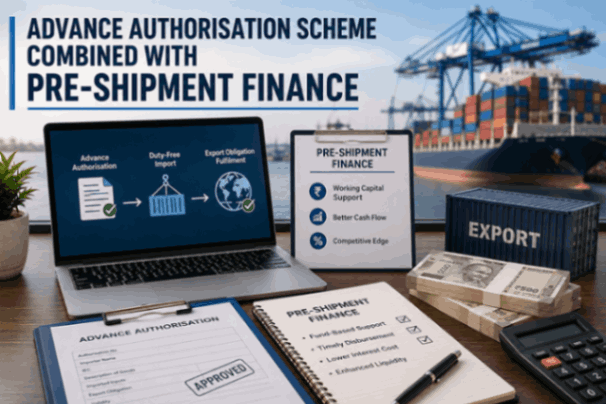
Exporters often face two separate financial pressures before an order is shipped. They require suitable inputs in production while providing funding for manufacturing, processing, labour, and packaging. Managing both requirements efficiently can help protect working capital throughout the export cycle.
The advance authorisation scheme and pre-shipment finance address different parts of this requirement. Advance Authorisation can enable eligible inputs to be imported without applicable customs duties, subject to scheme conditions and export obligations. Whereas pre-shipment finance provides working capital for activities undertaken before export shipment.
Used with the right transaction structure, these mechanisms can support a more efficient export working capital strategy.
Two Export-Finance Tools With Different Roles
Advance Authorisation primarily addresses the input side of export production. Under the scheme, eligible inputs can be imported duty-free when they are physically incorporated into the resultant export product, subject to applicable conditions. An export obligation is usually attached to the authorisation.
Pre-shipment finance addresses the working-capital side. It can finance the purchase, processing, manufacturing, or packing of goods before shipment against an export order, letter of credit, or other acceptable evidence of an export order.
This distinction between the two is important. One mechanism can reduce eligible input-related cash outflows, while the other provides funding for the broader export-production cycle.
Where Advance Authorisation Can Reduce Upfront Input Costs
For exporters dependent on imported raw materials or components, input costs can create a substantial cash requirement before production begins.
The Advance Authorisation Scheme can help eligible exporters manage this burden by permitting duty-free import of qualifying inputs, subject to the applicable norms and conditions.
The authorisation may be based on Standard Input Output Norms, self-declaration under applicable provisions, prior fixation of norms, or the Self Ratification Scheme, depending on the circumstances.
However, exporters should not treat the authorisation as permission for duty-free procurement. The imported inputs must satisfy the conditions attached to the relevant authorisation, including applicable input-output norms and export obligations.
Also read: What is Advance Authorisation Scheme?
Where Pre-Shipment Finance Fills the Working-Capital Gap
Even when an exporter can access eligible inputs under Advance Authorisation, other production expenses still require funding.
This is where pre-shipment finance for exporters becomes relevant.
Banks may provide pre-shipment or packing credit for activities such as procuring, processing, manufacturing, and packing goods before shipment. The financing period is generally determined according to the requirements of the individual export order and the time needed to complete production and shipment.
The facility can therefore support costs that are not addressed simply by obtaining an Advance Authorisation.
Read: Pre-Shipment Finance Meaning, Working, and Benefits
How Both Work Together Across the Export Cycle
The commercial relationship becomes clearer when viewed across a single export order. The key stages are outlined below:
- Secure the export order
- Obtain Advance Authorisation
- Source eligible inputs
- Fund production through pre-shipment finance
- Manufacture and ship
- Realise export proceeds
Suppose an exporter receives an overseas order requiring imported raw materials. The exporter may use Advance Authorisation for eligible inputs, subject to the applicable scheme requirements.
The exporter may separately arrange pre-shipment finance to support manufacturing, processing, packaging, labour, and other eligible working-capital requirements.
This creates a distinction between reducing eligible input-related costs and funding the operating cycle.
The two mechanisms therefore do not replace one another. They can address different financial requirements within the same export transaction.
The Cash-Flow Advantage of Combining Both
The biggest potential advantage lies in managing the timing of cash outflows. Without an appropriate financing structure, an exporter may need to fund imported inputs and production expenses before receiving payment from the overseas buyer.
Advance Authorisation can reduce the eligible duty burden associated with qualifying inputs. Pre-shipment finance can then help fund the working-capital requirement involved in converting those inputs into export-ready goods.
This can help exporters preserve liquidity for other operating requirements, provided the financing is appropriately structured and the transaction meets applicable conditions.
The objective is not simply to reduce costs. It is to align funding with the exporter’s production and collection cycle.
A Practical Example of the Combined Approach
Consider an exporter with a ₹50 lakh export order requiring imported inputs worth ₹20 lakh. If those inputs qualify under the exporter’s Advance Authorisation, the applicable duty benefit can reduce the upfront customs-duty outflow, subject to the authorisation’s terms.
The exporter may still need funds for domestic processing, manufacturing, labour, packaging, logistics, and other eligible pre-shipment expenses. Pre-shipment finance can help address that working-capital requirement.
The financial roles are therefore distinct:
- Advance Authorisation: Helps manage eligible input-related duty costs.
- Pre-shipment finance: Helps fund eligible export-production requirements.
The actual benefit will depend on the exporter’s transaction structure, eligibility, financing terms, and compliance with applicable conditions.
What Exporters Must Coordinate Before Using Both
Combining advance authorisation and pre-shipment finance requires proper coordination between the trade documentation and financing arrangements.
- Align Input Requirements With the Authorisation
The inputs imported under the authorisation must correspond with the applicable norms and resultant export product. Exporters should verify eligibility before committing to procurement.
- Match Finance With the Production Cycle
The pre-shipment facility should reflect the actual time required to procure, manufacture, process, pack, and ship the goods. RBI guidance states that banks determine the period of packing credit based on the circumstances of the individual case.
- Maintain Clear Transaction Records
Import documents, export orders, authorisation records, production details, and financing documents should remain properly aligned.
- Monitor Export-Obligation Requirements
Advance Authorisation carries export-obligation conditions. Exporters must track the applicable requirements and complete them within the prescribed framework.
When Does This Strategy Make Commercial Sense?
The combination can be particularly relevant for exporters with significant imported inputs and substantial pre-shipment working-capital requirements.
It may also suit businesses with longer production cycles, recurring export orders, or substantial gaps between procurement and export-realisation timelines.
However, exporters should assess the complete transaction before adopting this approach. The availability of an Advance Authorisation benefit does not automatically mean that pre-shipment finance will be the most suitable funding option.
The financing requirement, order value, input profile, production cycle, repayment source, and applicable regulatory conditions should all be evaluated together.
Building a More Efficient Export-Finance Strategy
For growing exporters, trade finance works best when individual facilities are considered as part of the wider cash-flow cycle.
Credlix helps businesses explore digital trade-finance solutions aligned with their working-capital requirements and trade transactions. For exporters using mechanisms such as Advance Authorisation alongside pre-shipment funding, a structured approach can help separate input-related benefits from actual financing requirements.
The result is a more disciplined approach to export working capital, where funding decisions are aligned with procurement, production, shipment, and receivables rather than handled as isolated financial requirements.
FAQs
Can Advance Authorisation and pre-shipment finance be used together?
Yes, they address different requirements within an export transaction. Advance Authorisation concerns eligible duty-free import of inputs subject to scheme conditions, while pre-shipment finance supports eligible working-capital requirements before shipment. The usage together depends on the exporter’s eligibility, transaction structure, financing arrangement, and compliance with applicable requirements.
Does Advance Authorisation reduce the cost of pre-shipment finance?
Not directly. Advance Authorisation and pre-shipment finance address different financial requirements. Advance Authorisation can reduce eligible duty-related input costs, while pre-shipment finance provides working capital for export production. The overall financial benefit will be dependent on the transaction, financing cost, eligible inputs, export obligation and applicable scheme conditions.
What should exporters consider before combining both?
Exporters need to assess eligible inputs, the export obligations, production schedules, working capital requirements, financing arrangements, documentation and the regulatory conditions. They should also make sure that the financing need is clearly stated and there is proper documentation of the underlying export transaction. It can be helpful to get professional advice from the relevant bank or trade-finance provider for proper arrangement.
