
- April 10, 2026
- Posted by: Rishabh Agrawal
- Categories: Business Fundamentals, Blog
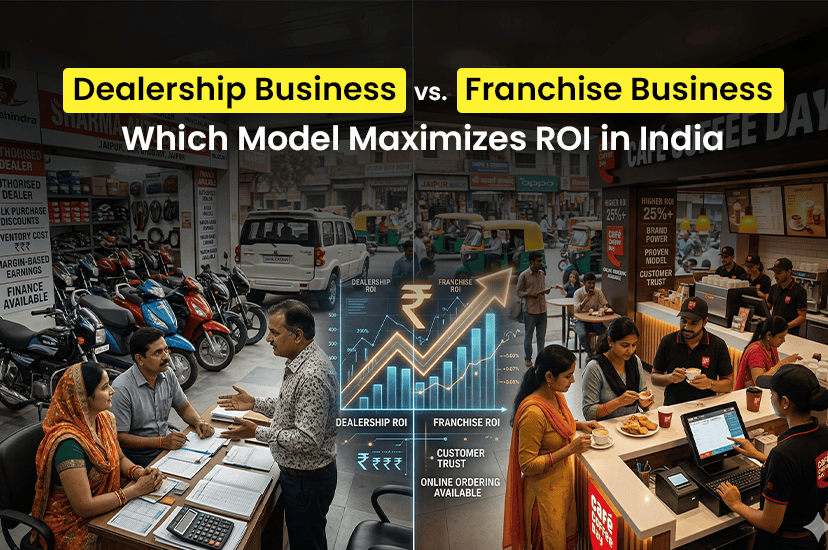
The selection of an appropriate business model is a very important choice for an entrepreneur aiming to enter or increase business in the competitive Indian market. Two of the most popular alternatives, dealerships and franchises, provide organized pathways for developing a business with recognized brands. The two models, however, have differences in investment, control, risk, and profitability.
For a business owner seeking high returns, it is important to understand the effect of every model on the earnings. It is not only a choice regarding brand association but also a choice regarding cost structure, flexibility in operations, and scalability in the long run. Comparing dealership and franchise businesses in India assists the entrepreneur in determining which business model fits best in his financial objectives and market approach.
Using comparisons of these models in the main areas of focus, including investment, control, and revenue potential, businesses will have a better decision-making tool and will be able to select a structure that will yield maximum advantages in investment.
What Is a Dealership Business?
A dealership business is a model in which an individual or firm buys products from a manufacturer or supplier and resells them to customers within a specified territory. The dealer achieves profitability in the margin of products sold while operating within the agreed terms.
What Is a Franchise Business?
The franchise business model gives one a chance to run a business in the name of an already existing brand and its systems and processes. The franchisee is usually required to pay a start-up fee and recurring royalties in exchange for brand recognition, training, and standardized processes.
Key Differences Between Dealership and Franchise Models
Although both of these models involve selling products or services under a bigger brand ecosystem, the structure of both models significantly differs.
- Investment and Cost Structure
Initial investment needed in either of the models depends on the industry and size of operation.
In a dealership business, the main costs associated with this business are inventory purchase, storage, and distribution. Recurring royalty payments are not usually present, and so it is cost-efficient in the long run.
In contrast, a franchise business in India involves
- Initial franchise fees.
- Set up and branding costs.
- Continuous royalty or revenue sharing.
These extra expenses may affect the overall profitability, particularly during the initial stages.
- Revenue Potential and Profit Margins
The profitability is based on the way in which each model will generate revenue and control the costs.
A dealership model ROI is driven by:
- Sales volume.
- Profit margins on products.
- Effective inventory control.
Dealers are allowed to control price strategies, and this can enhance margins.
Contrastingly, franchise business profitability depends on:
- Brand strength and demand in the market.
- Location and number of customers.
- Capability to control operating expenses.
A franchise has the advantage of having an established brand name at the expense of the royalty payments that decrease the net earnings.
- Operational Control and Flexibility
One of the aspects in the comparison of these models is operational freedom.
Dealership businesses are more in control of pricing, operations, and customer relationships. This is flexible enough to enable them to change with the market.
In a franchise system, operations are uniform. Franchisees are bound to abide by rigid brand standards, which removes the flexibility but provides uniformity between locations.
Risk Factors in Both Models
Every business model is associated with risks.
Dealership risks include:
- Reliance on the reliability of the supplier.
- Problems in inventory management.
- Market demand fluctuations
Franchise risks include:
- High upfront investment
- Reliance on brand recognition.
- Preset royalty fees irrespective of profit.
Assessment of these risks assists businesses in selecting the appropriate business model to maximize ROI in India.
Scalability and Growth Opportunities
The growth potential also depends on the ease with which the business can scale operations.
The dealerships may expand their product lines, territories, or join in collaboration with many suppliers. This makes them favorable to businesses desiring flexibility in growth.
Franchises multiply with uniform expansion, which is the possibility of having several outlets under one brand. Expansion, however, might demand more franchise fees and approvals.
To maximize long-term returns, it is necessary to learn about scalability.
Which Model Maximizes ROI in India?
The choice between dealership and franchise depends on business objectives, risk-taking, and available capital.
- Businesses that look for greater control and reduced recurring costs should choose a dealership.
- Franchises may be of use to businessmen who seek a brand presence and a well-organized operation.
There is no one-size-fits-all solution. The right model depends on how effectively businesses can manage costs, operations, and market positioning.
Evaluating the Right Business Model for Long-Term Returns
The dealership and franchise models have strong prospects of entrepreneurship in India. Dealerships offer flexibility in operations and margins in terms of earnings, whereas franchises offer a brand name and a structured business.
Careful consideration of the investment needs, control levels, and profitability aids companies in the choice of a model that fits their financial objectives. Making the right choice ensures sustainable growth and better return on investment over time.
Credlix Financial Solutions for Business Expansion
Growth of dealership or franchise business usually involves regular availability of working capital to purchase inventories, operations and expansion programs. Credlix offers trade finance services that assist corporations in accessing liquidity that is locked in outstanding bills and transactions.
With faster access to capital and flexible financing options, Credlix ensures that businesses operate efficiently and maintain liquidity, regardless of the chosen business model.
Frequently Asked Questions
Q1: What is the difference between a dealership and a franchise?
A dealership is independent in terms of buying and selling products, whereas a franchise is under a system of a brand and pays fees or royalties to use its name and processes.
Q2: Which is the more profitable business model in India?
The profitability is dependent upon the investment, cost structure, and market demand. A dealership can provide greater margins, whereas franchises are advantageous due to brand recognition.
Q3: Are dealership businesses or franchises safer?
Franchises are more supportive and brand-aware, perhaps lowering the risk in the market, but they are expensive and lack operational flexibility because of their nature, unlike dealerships.
