
[vc_row][vc_column][vc_column_text][/vc_column_text][/vc_column][/vc_row][vc_row el_class=”padding-sm-bottom-40″][vc_column offset=”vc_col-lg-8 vc_col-md-8″ el_class=”post-details-sec”][vc_single_image image=”11718″ img_size=”full” css=”.vc_custom_1703571377881{margin-bottom: 44px !important;}”][vc_row_inner css=”.vc_custom_1608297138483{margin-bottom: 0px !important;}”][vc_column_inner][vc_column_text]Did you know there’s a financial secret that savvy businesses use to save money and use it somewhere productive? It’s called “Early Payment Discounts,” and it’s like a hidden treasure in the world of accounts payable. Imagine turning paying bills into a game where you win by saving money!
In this blog, we’ll dive into the enchanting realm of early payment discounts, unraveling the magic that businesses use to turn timely payments into a source of real value. Get ready to discover the wizardry of unlocking savings in your accounts payable!
What is an Early Payment Discount?
An Early Payment Discount is an incentive offered by a seller to a buyer for settling an invoice or bill before the agreed-upon payment due date. It’s a discount or reduction in the total amount owed, provided as a reward for prompt payment.
This benefits both parties – the buyer saves money, and the seller gets paid sooner, improving cash flow. Early Payment Discounts are commonly expressed with terms like “2/10, net 30,” indicating a 2% discount if paid within 10 days, with the total amount due in 30 days.
Usually, suppliers traditionally offer prompt payment discounts ranging from 1% to 5% to encourage early payment by buyers. However, a rising trend is dynamic discounting, where either the buyer or the seller can initiate discounts. Terms are agreed upon before invoicing, adding flexibility to payment arrangements.
Suppliers have lots of ways to give discounts to customers. It depends on how well they know the buyer and how easy or tricky they want to make it for the buyer to pay early.
Also Read: What is an Early Payment Discount? A Complete Guide
Understanding the Flip Side of Early Payment Discounts
When you miss the due date on an invoice, the opposite of early payment discounts comes into play – it’s called invoice late fees. These fees are like extra charges added to your bill as a penalty for paying after the agreed-upon due date. So, while early payment gets you discounts, paying late could mean extra costs. It’s a good idea to stay on top of those due dates to keep your expenses in check!
Types of an Early Payment Discount
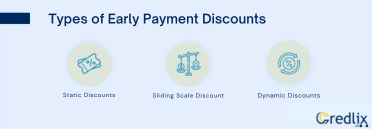
Let’s understand the different types of early payment discounts:
Static Discounts
Static discounts are the most common early payment discounts. They’re like a set deal – you get a fixed discount if you pay early, and the terms are right there on the invoice.
Imagine your supplier says, “Pay within 7 days, and you get 3% off!” It would show up on the invoice as “3/7 – net 30.”
Now, let’s say Sarah gets a $1,000 invoice with these terms. If she pays by the 7th day, she gets $30 off: $1,000 x 3% = $30. So, she only has to pay $970.
But if Sarah waits beyond the 7 days, no worries, she can still pay the full $1,000 by the 30th day. It’s a simple way to save some money if you can pay a bit earlier!
Sliding Scale Discounts
Think of sliding scale discounts as a more flexible way to save money when you pay an invoice early. Let’s say, instead of a fixed “pay in 10 days and get 3% off” deal, it’s more like a sliding scale.
So, if Lisa gets a $2,000 invoice with this sliding scale discount, she could take the whole $40 discount if she pays within ten days. But here’s the cool part – even if she pays on day 15, she can still save $20!
With sliding scale discounts, you get a bit of the discount no matter when you pay early, but it gradually gets smaller each day after the initial ten days. It’s a flexible way to keep some extra cash in your pocket!
Dynamic Discounts
Meet dynamic discounts – the newest way to save money on big invoices. Unlike fixed or sliding scale discounts, dynamic discounts are like a special deal you work out with the seller for each invoice.
So, imagine Jane gets a $5,000 invoice from her usual supplier, Mountain Metals. Because she’s a loyal customer, she gives them a call. They agree that if she pays within ten days, she gets a $200 discount. If she pays within 15 days, it’s still a deal, but the discount drops to $150. Paying within 20 days? Jane can take a $50 discount.
She decides to pay $4,800 within ten days, keeping both her and Mountain Metals happy. But remember, this is a one-time deal. Next time, Jane needs to talk about discounts again if she wants to save more. It’s like a personalized money-saving chat with each invoice!
Benefits of Early Payment Discounts
Early Payment Discounts, a strategic financial maneuver, bring forth a multitude of advantages for businesses.
1. Cost Savings
Paying bills quickly isn’t just good manners; it’s a smart money move. When businesses settle invoices quickly, they pocket discounts, making their financial standing stronger. It’s like a secret weapon – paying on time, saving money, and staying ahead in the game.
It’s not just about paying bills; it’s about making money moves that keep businesses in the winning league.
2. Improved Cash Flow
Timely payments do more than meet due dates; they supercharge a business’s financial agility. By enhancing cash flow, they create a financial cushion, offering liquidity and flexibility for strategic maneuvers and unforeseen opportunities.
It’s not just about paying bills on time; it’s about sculpting a resilient financial landscape that empowers businesses to navigate the twists and turns of the market with ease.
3. Strengthened Supplier Relationships
Paying early isn’t just about numbers; it’s about people. Early payments build trust and stronger bonds with suppliers.
These relationships aren’t just transactions; they’re investments in a future where favorable terms and collaborative opportunities flourish. It’s like planting seeds for a garden that grows prosperity for everyone involved.
4. Enhanced Negotiation Power
Committing to timely payments isn’t just a gesture; it’s a strategy. Businesses, armed with a track record of prompt payments, step into negotiations with confidence, wielding enhanced bargaining power that opens doors to even more favorable terms and mutually beneficial agreements.
It’s not just about paying on time; it’s about setting the stage for collaborative success.
5. Reduced Financial Stress
Consistent early payments aren’t just a habit; they’re a remedy. They act like a soothing balm, reducing financial stress for businesses. This financial calmness becomes a sturdy anchor, helping companies navigate uncertainties with confidence and weather the unpredictable tides of the business world.
It’s not just about paying bills early; it’s about creating a resilient harbor that shields businesses from the storms of financial uncertainty.
6. Streamlined Accounts Payable
Imagine early payments as the magic wand that makes handling bills a breeze. By embracing discounts, businesses not only save money but also make their finance work smoother.
It’s like having a helpful assistant that organizes everything, making the process easy and stress-free. Early payments don’t just save dollars; they save time and make accounts payable a hassle-free journey.
7. Boosted Creditworthiness
Paying bills on time isn’t just about avoiding late fees; it’s like flexing a financial superpower. When businesses pay promptly, it’s a thumbs-up for their credit history. This superhero move enhances their creditworthiness, making it easier to get good deals on loans and other money matters.
It’s like building a strong financial reputation that opens doors to better opportunities. Early payments aren’t just about settling bills; they’re about becoming financial superheroes with a robust credit standing.
8. Competitive Edge
Picture early payments as the secret ingredient in a business success recipe. By grabbing those discounts, businesses don’t just save money; they gain a superpower – a competitive edge. It’s like having a special tool that makes them stand out in the business crowd.
This smart move doesn’t just optimize their finances; it propels them ahead, making them leaders in the game. Early payments aren’t just about saving dollars; they’re about securing a front-row seat in the race for success.
Disadvantages of Early Payment Discounts
Both buyers and suppliers need to weigh these potential disadvantages against the benefits before committing to early payment discounts.
Cash Flow Challenges for Buyers
Early payments, especially on large invoices, can create cash flow issues for buyers, potentially affecting their ability to pay other invoices on time.
Potential Cash Flow Mismanagement
Prioritizing early payments on one invoice may lead to late payments on others, causing cash flow mismanagement for buyers.
Impact on Supplier Financials
For suppliers with tight operating margins, even a small early payment discount can impact their financials negatively.
Risk of Unfulfilled Early Payments
Suppliers may face the risk of customers taking early payment discounts but not paying early, leaving suppliers with reduced margins without the benefit of early payment.
Operational Burden
Managing early payment discounts can add complexity to operations, requiring efficient systems to avoid financial pitfalls.
Easy Ways to Get Early Payment Discounts
Getting early payment discounts doesn’t have to be a puzzle. Here are easy ways to make it happen:
Stay Organized
Keep track of your invoices and due dates. Set up reminders to ensure you never miss a chance for an early payment discount.
Automate Your Process
Consider using software like Planergy to streamline your accounts payable. Automation speeds up approvals, making it easier to take advantage of discounts.
Build Strong Relationships
Maintain good relationships with your suppliers. Sometimes, a friendly conversation can lead to better payment terms and discounts.
Negotiate Terms
Don’t be afraid to negotiate. Discuss early payment discounts with your suppliers and find terms that work for both parties.
Optimize Cash Flow
Keep your cash flow in check. Having a healthy cash flow allows you to take advantage of discounts without straining your finances.
Be Aware of Terms
Understand the payment terms offered by your suppliers. Some may have discounts for early payments that you might miss if you’re not aware.
Are Early Payment Discounts a Good Idea?
Are you still figuring out if early payment discounts are a good deal? Well, the answer is yes! They’re like a win-win for both sellers and buyers.
For Sellers:
Cash Boost: Sellers get their money faster, which is great for their wallets.
Less Hassle: They spend less time chasing late payments.
For Buyers:
Save Money: Buyers can save a lot by paying early.
Credit Boost: It’s like a good deed for their credit score.
Both sellers and buyers become buddies through early payment discounts. It’s not just about money; it’s about trust and good relationships. But here’s the trick – make sure your payment process is super smooth. That way, discounts happen like magic, making everyone happy! Early payment discounts are a thumbs-up for sellers and a high-five for buyers when done right.
Final Words
So, that’s the scoop on early payment discounts – it’s like finding hidden treasures in the world of paying bills. Businesses that grab these discounts are like financial wizards, turning regular payments into smart moves.
Paying bills early isn’t just about saving money; it’s about building trust, making friends with suppliers, and being a champion in the business game. But, like any game, there are tricks to it. Keep your payment process smooth, and these discounts become pure magic, making everyone happy!
So, here’s to early payments – the secret sauce for a winning financial strategy!
Also Read: Early Payment Discounts: Should You Use Them in Your Business?
FAQs
Can early payment discounts be negotiated for every invoice?
Negotiating early payment discounts for every invoice is possible, but it depends on supplier flexibility. Building strong relationships and open communication can increase the likelihood of such arrangements.
Are there industries where early payment discounts are more common?
Yes, industries with shorter cash conversion cycles, like retail, often see more common use of early payment discounts. However, adoption can vary across sectors.
How does early payment frequency impact a buyer’s credit score, and what’s the optimal strategy for leveraging benefits without straining cash flow?
Regular early payments positively impact a buyer’s credit score, showcasing financial responsibility. The key is balancing early payments to maximize benefits without affecting overall cash flow adversely.
Can dynamic discounting lead to confusion for businesses dealing with multiple suppliers?
Yes, managing dynamic discounts from multiple suppliers can be complex. Clear communication, robust systems, and regular reviews can help minimize confusion and optimize benefits.
Do suppliers offer different types of early payment discounts simultaneously, and how can buyers navigate such situations?
Yes, suppliers may offer various discounts concurrently. Buyers can navigate by understanding each discount type, negotiating terms, and prioritizing payments based on strategic considerations.
Do early payment discounts apply uniformly across products or services, or do they vary based on the transaction?
Early payment discounts can vary based on the supplier’s policies and the nature of the transaction. Buyers need to review the terms for each purchase.
What challenges do businesses face in implementing automated accounts payable systems for seamless early payment processes?
Challenges in implementing automated systems may include initial setup costs, integration issues, and staff training. However, overcoming these challenges leads to more efficient and seamless early payment processes.
Can early payment discounts be strategically used as part of a broader financial strategy?
Yes, early payment discounts can be part of a strategic financial approach. Some businesses may intentionally forgo discounts if it aligns with a broader financial strategy, such as preserving cash for strategic investments.