
- December 31, 2025
- Posted by: admin
- Category: Export Financing
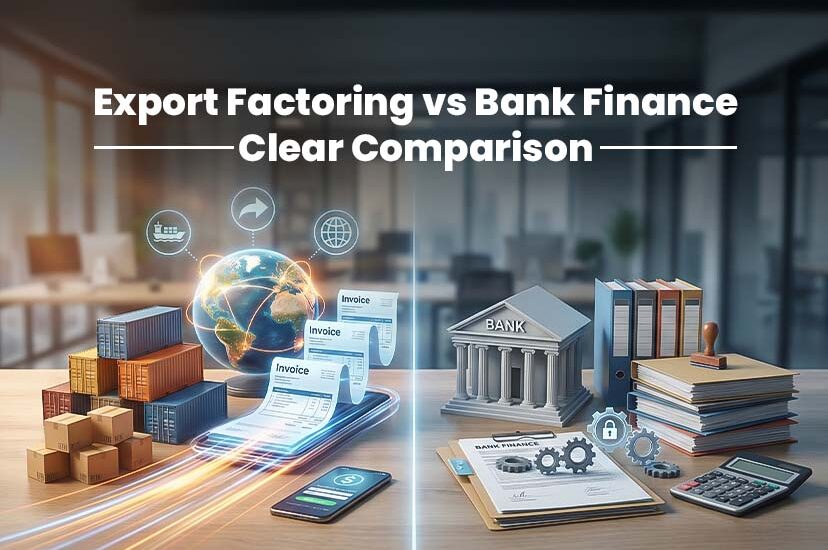
For exporters, the timely availability of funds can determine whether shipments progress smoothly or operations stall. Export financing is more complicated than financing domestic trade because of long payment cycles, risks of overseas buyers, and currency exposure. Export Factoring and bank finance are two of the most popular sources of funds used by exporters, each with distinct structures and risk considerations. Although both aim to provide liquidity, they work very differently in practice.
This blog contains a concise, practical comparison of export factoring and traditional bank finance, which assists exporters in selecting the most appropriate mode, depending on the cash flow requirements, riskiness, and the stage of growth.
Understanding Export Financing in Global Trade
The exporters typically ship goods before receiving payment. It is common to have credit periods of 30, 60, or even 120 days, which creates pressure on the working capital for exporters. To fill this gap, companies depend on organized export financing solutions that convert outstanding bills into usable working capital.
The selection of the appropriate financing model is fundamental to the maintenance of liquidity, risk management, and the stability of exports.
What Is Export Factoring?
Export Factoring is a financing option that allows exporters to sell their export invoices to a factoring company in exchange for immediate cash. Exporters typically receive a large percentage of the invoice value upfront, instead of waiting for overseas buyers to pay.
Beyond funding, export factoring usually includes services such as buyer credit evaluation, collections, and, in some instances, even buyer default cover. This makes export receivables financing a liquidity as well as risk-management instrument.
What Is Bank Finance to Exporters?
Bank finance for exporters is normally available in the form of pre-shipment credit, post-shipment finance, packing credit, and bill discounting. Access to these facilities depends on the exporter’s balance sheet strength, collateral availability, and credit history.
Although banks continue to be a conventional source of export credit, their processes are often documentation-intensive, time-consuming, and less flexible in meeting the needs of fast-growing exporters.
Core Difference: Export Factoring vs Bank Finance
The key distinction between export factoring and bank finance lies in how risk is assessed and funding decisions are made. Export factoring is concerned with the finances of the foreign purchaser, whereas bank finance relates to the financial capability of the exporter. This fundamental difference significantly affects the accessibility, speed, and flexibility of financing for exporters.
- Speed of Access to Funds
Speed of funding is critical in export operations, where delays can disrupt production and shipment schedules. Under export factoring, money is usually disbursed within 24 to 72 hours of submission and verification of the invoice. This rapid access to funds supports uninterrupted production and timely shipments.
In contrast, bank finance for exporters takes longer approval periods as a result of credit appraisal, collateral checks, and internal approvals, which can delay access to funds for exporters.
- Collateral and Security Requirements
One of the key advantages of export factoring is that it typically does not require traditional collateral. The invoice serves as the main security.
Bank finance, however, may need collateral, such as property, fixed deposits, or personal guarantees. For many SMEs, this requirement restricts access to trade finance, particularly during early growth stages.
- Risk Coverage and Buyer Protection
Export factoring may offer protection against buyer default, depending on whether the facility is structured with or without recourse. This is an important feature, especially in international trade, where cross-border legal recovery is complicated.
Buyer default risk is not generally covered by traditional export credit financing by banks. In case of failure of the buyer to pay, the exporter remains fully liable for repayment.
- Impact on Balance Sheet and Credit Lines
Balance sheet treatment is another significant dissimilarity between export factoring and bank finance. Export factoring is often structured as an off-balance-sheet arrangement, which can improve liquidity ratios and preserve borrowing capacity.
Bank loans, on the other hand, augment liabilities and can limit access to future credit due to increased leverage and credit exposure.
- Flexibility and Scalability
As export volumes grow, funding requirements increase proportionately. Export factoring is naturally proportional to sales, since funding is directly linked to the invoice value.
Bank finance facilities are generally limited and have to be renewed or renegotiated periodically. This can constrain growth and delay expansion plans, particularly for exporters with seasonal demand patterns.
- Cost Structure and Transparency
The cost of export financing usually involves financing costs and factoring costs. While these costs may appear higher at first glance, they often cover multiple services such as credit protection, collections, and receivables management.
The costs of bank finance comprise interest, processing fees, documentation fees, and compliance costs. In cases where opportunity costs and delays are considered, traditional bank-based export financing is not always the most economical option.
- Suitability for MSME Exporters
For small and medium exporters, the availability of finance is usually limited due to a lack of collateral and operating histories. Export factoring offers an alternative MSME export finance model that focuses on buyer quality rather than exporter size.
Banks generally prefer established exporters with strong balance sheets. This makes factoring a more inclusive and accessible trade finance option for exporters.
- Documentation and Administrative Burden
Export factoring reduces the administrative burden by handling collections and receivables management. This enables exporters to focus on production and market expansion.
Bank finance entails a lot of paperwork, periodic reviews, and compliance audits, which can strain internal resources, particularly for lean export teams.
When Bank Finance May Be the Right Choice
Bank finance can be a suitable option for exporters with strong collateral positions, predictable cash flows, and long-standing banking relationships, despite its limitations. It is particularly useful for capital-intensive investments and long-term funding requirements.
However, for day-to-day liquidity needs and receivables financing, export invoice factoring often proves to be a more efficient solution.
Choosing the Right Export Financing Model
The choice between export factoring and bank finance should be guided by the following factors:
- Cash flow urgency
- Buyer risk exposure
- Collateral availability
- Growth plans
- Administrative capacity
Many exporters adopt a hybrid approach, using bank finance for long-term funding needs while relying on factoring to meet working capital requirements.
Making the Right Financing Choice for Sustainable Export Growth
Choosing the appropriate funding model is essential for exporters operating in competitive international markets. Although banks provide structured and conventional export credit financing, export factoring provides faster access to funds, greater flexibility, and reduced buyer risk. Understanding these differences enables exporters to align financing decisions with their cash flow needs, growth objectives, and risk tolerance, supporting smoother operations and stronger financial resilience.
Credlix enables exporters to access instant liquidity through export factoring and receivables-based financing solutions. The Credlix team helps exporters overcome long credit cycles, reduce payment risk, and scale confidently in global markets by converting unpaid export invoices into working capital. With fast processing and deep trade-finance expertise, Credlix supports exporters across all stages of growth.