
- February 26, 2026
- Posted by: admin
- Categories: Invoice discounting, Blog
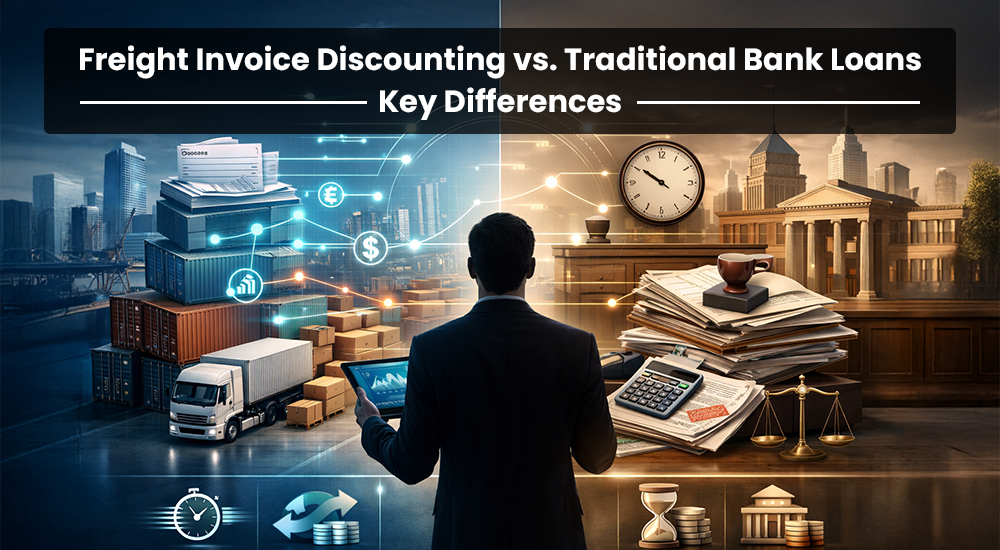
The cash flow is critical in operations in the modern market that is highly competitive in terms of logistics. Freight bill discounting is a relatively new trend that has started replacing the conventional bank loan because it is quicker to access, as well as the collateral requirements are minimal. Although these two options might offer liquidity, their constructions, eligibility requirements, and influence on business activities are very diverse. It is these differences that make companies wiser in their financial decisions and optimize their working capital financing strategy.
What is Freight Bill Discounting?
Freight bill discounting enables the logistics providers, exporters and transport operators to turn the unpaid freight invoices into cash. Companies do not have to wait 30 to 90 days to get payments from their clients, but they can submit verified freight bills to a financial institution and get access to up to 80 to 90 per cent of the invoice value within a few seconds. The financier will then receive the payment due dates of the client. It is a rapid financing structure that enhances liquidity status and helps to manage cash flows regularly.
What Are Traditional Bank Loans?
Contrary to freight bill discounting, conventional bank loans will demand that businesses request a lump sum of credit, which is typically guaranteed by assets or guarantees. Approval is done with elaborate credit checks, business documentation, and security checks. The amount is released as fixed cash, and the bank sets the rates of repayment and interest. Bank loans are also not as flexible in logistics funding to businesses that are undergoing temporary liquidity challenges, unlike in long-term projects.
Traditional Bank Loans vs. Freight Bill Discounting – A Closer Look
- Speed and Accessibility
The greatest benefit of freight bill discounting is that it is fast. After a company provides its authenticated invoices, the money is disbursed within days, even hours. Bank loans, on the other hand, may take weeks or months to be processed because of the tedious background checks and compliance procedures. Quick turnaround of Freight Bill would be of great advantage to logistics companies that require constant power, maintenance and shipping costs.
- Security Requirement and Collateral
Conventional bank loans normally require physical security like real estate, equipment or a fixed deposit. Startups and other small logistics players can hardly comply with such requirements. In freight invoice discounting, the invoices themselves serve as collateral and further guarantees are not needed. This renders the working capital financing more viable to smaller or asset-light companies in the freight and export industries.
- Impact on Cash Flow
Cash flow management is crucial to logistics operations. The freight invoice discounting helps to close the payment period between settlement and delivery of services to the customers. The short-term cash disbursement assists companies in paying their drivers, suppliers, and customs charges immediately. Conversely, bank loans are one-time finances and may not support the seasonal freight shipments. Frequently, Invoice-based financing becomes more responsive to current trends in receivables.
- Cost and Interest Structure
Although both alternatives are costly, freight bill discounting is generally accompanied by fewer total costs when it comes to short-term requirements. The financier will pay a small discounting fee depending on the value of the invoice and the time frame. With the bank loan, there is an interest rate, processing charges and potential prepayment penalties. In the case of companies that have regular shipments, the invoice-based trade finance solutions are usually cheaper and clearer.
- Documentation and Compliance
Conventional bank loans entail detailed financial reports, business background and credit evaluations. It is a bureaucratic process that is paperwork-intensive. Freight invoice discounting, in its turn, is more concerned with confirmed freight bills, delivery documentation and customer credibility. The less paperwork will enable the logistics companies to get swift funding in logistics without wasting administrative time.
- Repayment Flexibility
The difference between the two lies in the way repayment is organized. Bank loans are subject to monthly EMIs that are fixed, irrespective of whether the business has cash or not. In freight bill discounting, the end customer pays the invoice, and this automatically leads to repayment. It is a flexible model that matches financing to the actual business cycles, which minimizes the strain on the day-to-day business activities and assures easier daily cash flow management.
- Risk Exposure
According to the financial risk perspective, Freight invoice discounting only exposes itself to invoices that are submitted to it to be financed. Bank loans, on the other hand, raise the total debt of the company, and this influences credit scores and leverage ratios. Freight Bill is a more sustainable trade finance option, as exporters or logistics providers that deal with varying tonnage volumes of shipments require a liquidity facility that does not lead to long-term liabilities.
- Scalability and Growth Potential
Freight bill discounting is better in businesses that require scalability since it can increase with an increase in sales. The more the freight invoices are produced, the bigger the financing that the companies get without having to renegotiate terms. Bank loans, on the other hand, have certain limits that are fixed and require new applications to increase the amount. This flexibility helps to extend logistics operations, equipment modernization, and route expansion under the minimum financial pressure.
- Credit Analysis and Issuance
Conventional bank loans are very sensitive to credit rating, past performance, and the strength of the balance sheet. In freight invoice discounting, financiers check on the creditworthiness of the buyer or client and not the seller. This provides smaller companies in logistics, such as startups, with the benefit of accessing financing depending on the trustworthiness of its customers- a key benefit of new entrants in logistics financing.
- Suitability for Logistics Businesses
When the logistic companies have high receivables and long payment cycles, the agility of freight bill discounting is the capability that bank loans usually do not provide. It allows regular truck traffic, payment to suppliers on time and the conduct of intra-country business transactions. Bank loans remain relevant in financing long-term investments such as fleet expansion, but to achieve day-to-day liquidity, no match other than freight invoice discounting.
- Managing Seasonal Demands
The volume of freight usually changes according to the season. Companies need additional working capital funds because they need to meet the rising shipments during peak export or festival periods. Freight invoice discounting is a process that comfortably fits into these cycles as more invoices are converted to cash with increased volumes. Conversely, bank loans are inert, and funds are not available when there is high growth.
Accelerating Growth Through Smarter Financial Choices
The question of deciding on whether to use freight bill discounting or bank loans hinges on the business requirements, but this much is evident: invoice-based financing gives logistics providers the flexibility and control. It simplifies cash cycles, eradicates collateral obstacles and improves liquidity. Through effective implementation of freight invoice discounting, businesses will be able to work on their expansion, reliability, and customer satisfaction, which are the major pillars of success in the long run.
Credlix will allow exporters and logistics companies to receive immediate liquidity with freight invoice discounting. Credlix cares about transparency, low charges, and high-quality compliance services to convert receivables into working capital, which can ensure that the business operates smoothly and expands without blockage of financial resources.
FAQs–
- Is freight bill discounting superior to a bank loan among small logistics companies?
Yes, because with Freight invoice discounting, there is no collateral being secured, and the money reaches the company within a shorter time than conventional loans.
- Does freight invoice discounting impact the debt levels of companies?
No. It is not considered a liability but rather an instrument of receivables financing, thus it does not add to the total debt.
- Is it possible to combine both freight bill discounting and bank loans to do business?
Yes. It is not uncommon to see many companies mix both together to merge the short-term liquidity requirements and long-term funding requirements.