
- December 23, 2025
- Posted by: admin
- Categories: Export Financing, Blog
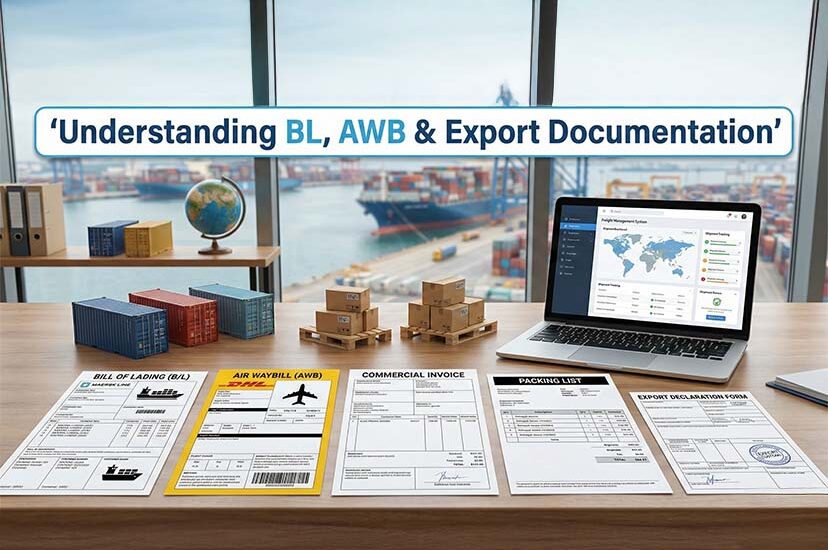
International trade operated on documentation. Exports cannot be moved without the proper paperwork, regardless of the high demand and the buyer’s trustworthiness. For the exporters, freight forwarders, and logistics companies, it is vital to learn the fundamentals of freight shipping documentation, such as the Bill of Lading and Air Waybill. This is vital to avoid delays, conflicts, and payment problems
Alongside financing instruments such as Export Factoring, proper export documentation is the centerpiece of success in cross-border trade. This guide describes the most important documents, their functions, and roles within the larger freight and compliance ecosystem.
Why Export Documentation Is Critical in Global Trade
All international deliveries have to be in accordance with customs and regulatory laws in different jurisdictions. Proper documentation on international trade practices spares an organization the hassle of having to move products within the legal limits and also get payments on a timely basis.
Poor or missing documentation often leads to cargo hold, fines, demurrage, or even rejection at the destination. This is the reason why exporters should consider shipping documents as the operational asset and not administrative formalities.
What Is a Bill of Lading?
The Bill of Lading is a document that is of paramount importance within ocean freight. It is printed by the carrier or freight forwarder and serves three purposes:
- Proof of shipment
- Documents on the contract of carriage.
- Document of title to the goods.
In the case of sea freight, the original BL of the shipment may frequently be used to establish who can claim the shipment at the destination. This puts the BL as an important aspect of cargo documentation and trade finance.
Types of Bill of Lading Used in Exports
Export shipment documents require different BL formats based on the various needs of a shipment:
- Original Bill of Lading – Needed in the event of transfer of title.
- Sea Waybill – It is used where no claim of ownership is required.
- Switch Bill of Lading – This is given to substitute original information.
- House BL and Master BL – Used in consolidated shipments.
Each type plays a role in risk management and compliance within the freight documentation process.
What Is an Air Waybill?
The main document that is used in air cargo shipments is the Air Waybill. An AWB is not a title document, unlike a BL. Instead, it acts as:
- Proof of receipt of goods
- Presentation of the agreement between the shipper and airline.
- Shipment tracking reference.
Since transfer of ownership is not associated with the AWB, air shipments are usually quicker and involve less documentation in the export factoring systems.
Key Differences Between BL and AWB
The difference between BL and AWB is critical to the exporter who needs to use sea or air freight:
| Aspect | BL | AWB |
| Mode of transport | Sea | Air |
| Document of title | Yes | No |
| Transferable | Yes | No |
| Speed | Slower | Faster |
| Common Use | Bulk & container cargo | Time-sensitive goods |
Such differences influence not only the decisions on logistics but also financing and risk exposure.
Other Essential Export Shipping Documents
In addition to the BL and the AWB, exporters must manage shipping documents for exporters that have to be handled when exporting outside of the country:
- Commercial Invoice
- Packing List
- Certificate of Origin
- Export Declaration
- Insurance Certificate
- Inspection Certificates (where applicable).
These form the foundation of compliant international trade documentation.
The Freight Documentation Process Explained
The freight documentation process usually follows a systematic order:
- Commercial contract concluded.
- Cargo booking with the carrier
- Shipping and customs document preparation.
- Handover, delivery of cargo and issue of BL or AWB.
- Customs clearance at the origin
- Movement of shipment and destination clearance.
Any flaw in one step can disrupt the whole supply chain, and the accuracy of the document is very important.
How Export Documentation Impacts Trade Finance
Trade finance instruments like the Export Factoring, invoice discounting, and letters of credit are highly dependent on authenticated documentation. BLs and AWBs are reviewed by lenders and financiers to verify that the shipments are legitimate and minimize the risks of fraud.
Wrong or mismatched documents might slow down the funding or risk being rejected, or create controversy. That is why it is clear that good documentation practices have a direct impact on cash flow and access to financing.
Common Documentation Challenges Faced by Exporters
Even experienced exporters face documentation-related risks such as-
- Inaccurate invoice and BL data.
- Wrong information about the consignee or the notify party.
- Lack of endorsements on original BLs.
- Delayed in document submission with banks.
This complicates the process of carrying out cargo documentation and may lead to holds in the shipment or late payment.
Best Practices for Managing Export Documentation
To simplify export documentation, the businesses ought to ensure that:
- Use standardized templates for shipping documents.
- Digitize the storage and retrieval of documents.
- Coordinate well with freight forwarders.
- Compare information in all papers.
- Keep compliance checklists per shipment.
The practices minimize errors and turnaround time during the freight documentation process.
Role of Digitalization in Export Documentation
Digital platforms are changing the world of international trade documentation. Electronic BLs, digital AWBs, and online systems of customs filing minimize paperwork, improve traceability, and compliance.
Digital documentation is also faster to verify in the case of exporters who use financing solutions, and thus, they can obtain funds much faster.
Why Mastering BL, AWB, and Export Documentation Matters
Documentation is essential to the world of international trade. The knowledge of the Bill of Lading (BL), Air Waybill (AWB), and other supporting export shipping documents will enable the business to avoid costly delays and protect ownership of cargo and also make payments at the right time. Properly done, documentation will enhance supply chains, financing access, and credibility among world markets.
Credlix assists exporters by facilitating access to liquidity via the Export Factoring and invoice discounting services. Businesses get a chance to access funds locked in receivables without having to wait until their buyers make payments through the use of verified shipping and trade documentation. We have a fast onboarding process and trade-focused expertise, which means that exporters can have a stable cash flow even when their business must handle intricate documentation procedures.
FAQs–
- Is every export shipment covered under a Bill of Lading?
Sea freight involves the use of a Bill of Lading, while air freight involves the use of an Air Waybill.
- Is it possible that exporters can use AWB as a means of trade finance?
Yes, AWBs can be generally used to finance air cargo, but they do not transfer title, such as a BL.
- What would happen in case some mistakes are found in export documents?
Mistakes in export documentation may result in delays in customs, cargo detention, money problems, or bank and financing rejection.