
[vc_row][vc_column][vc_column_text][/vc_column_text][/vc_column][/vc_row][vc_row el_class=”padding-sm-bottom-40″][vc_column offset=”vc_col-lg-8 vc_col-md-8″ el_class=”post-details-sec”][vc_single_image image=”12889″ img_size=”full” css=”.vc_custom_1715677643631{margin-bottom: 44px !important;}”][vc_row_inner css=”.vc_custom_1608297138483{margin-bottom: 0px !important;}”][vc_column_inner][vc_column_text]
When selling goods internationally, sorting out payment terms can feel like a tough task. Terms like CAD, DP, DA, LC, OA, and Advance Payments might sound like alphabet soup at first, but they hold the key to ensuring your exports reach their destination smoothly and securely.
In this guide, we’re going to break down these terms in plain language, so you can understand not just what they mean, but how they affect your business. Whether you’re a seasoned exporter or new into the global market, having a solid grasp of these terms will empower you to negotiate deals with confidence and avoid any surprises along the way.
So, let’s unravel the mysteries of export payment terms together. By the end, you’ll be armed with the knowledge you need to navigate the world of international trade like a pro. Let’s dive in!
What are Export Payment Terms?
Export payment terms are like the rules of the game in international trade. They decide how the money for goods or services will be paid between the exporter (the seller) and the importer (the buyer). It’s something they agree on together.
When you’re selling stuff overseas, there’s always a risk that you might not get paid. This risk is higher because of the distance and differences in laws between countries. To make things smoother, there are different ways to pay for exports. Some ways are better for the buyer, and some are better for the seller. Which one they choose depends on how they’ve worked together before and how much they trust each other.
Types of Payment Terms Used in Exports
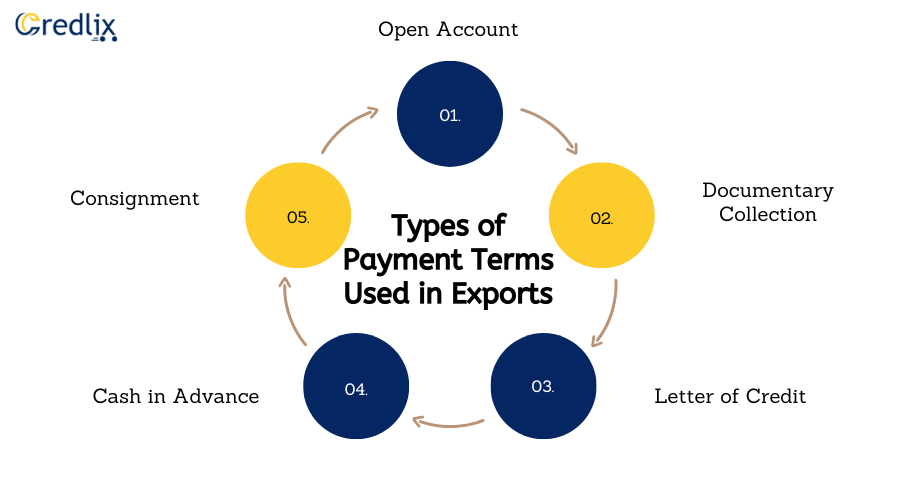
There are five main types of payment terms used in exports. They are:
- Open Account
- Documentary Collection
- Letter of Credit
- Cash in Advance
- Consignment
Open Account
In open account payment terms within international trade, the buyer accepts delivery of goods from the exporter and then settles the payment after an agreed-upon credit period. This credit period typically spans a fixed duration, such as 30 days, 60 days, or 90 days. During this period, there exists a gap between the receipt of the purchase order and the receipt of payment, with various activities like production and shipping occurring in between.
While this method offers flexibility to the buyer and may foster long-term relationships, it can strain the exporter’s working capital due to the delayed receipt of funds. Despite this, exporters might opt for open account payment terms if the importer is a reliable partner with potential for significant future transactions. Additionally, this method might be chosen based on a trusted relationship between the parties or if the financial risk involved is minimal.
Documentary Collection
In the documentary collection payment method, both the exporter and the importer engage their respective banks to facilitate the transaction. The exporter’s bank, known as the remitting bank, acts on behalf of the exporter, while the importer’s bank, known as the collecting bank, represents the buyer.
After the exporter ships the goods, they provide the shipping documents and a collection order to their remitting bank. The remitting bank then forwards these documents and instructions to the collecting bank. The collecting bank notifies the buyer of the documents and collects payment from them.
Once the payment is received, the collecting bank transfers the funds to the remitting bank, which then releases the documents to the buyer. Documentary collections can be processed either “at sight,” meaning immediate payment, or after a specified period.
There are two types of documentary collections:
a) Cash Against Documents (CAD) or Documents Against Payment (D/P):
In CAD payment terms, the buyer is required to make immediate payment upon presentation of the shipping documents. This payment is made before the buyer’s bank releases the documents, ensuring that the exporter receives payment before the buyer takes possession of the goods.
b) Document Against Acceptance (DA):
In DA payment terms, the buyer agrees to make payment after a specified period upon acceptance of a time draft. Once the buyer accepts the draft, the bank releases the documents, allowing the buyer to take possession of the goods.
Letter of Credit (LC)
A Letter of Credit (LC) is a widely used and secure payment method in international trade. It involves the buyer’s bank issuing a written guarantee, known as the Letter of Credit, to the seller. This letter serves as a promise that the buyer’s payment will be made according to the agreed-upon terms and conditions, providing assurance to the exporter of timely and secure payment.
Cash in Advance
Cash in Advance is widely regarded as the most secure payment method for exporters in international trade. In this arrangement, the exporter ships the goods to the buyer only after receiving payment in full or in part, depending on the agreed terms. Because the buyer bears the majority of the risk in this scenario, many importers are hesitant to agree to cash-in-advance terms.
Consignment
Consignment is a payment method in international trade that operates similarly to an open account. In this arrangement, payment is made to the exporter after the goods have been sold by a foreign distributor to the end customer.
Success in consignment exporting hinges on partnering with reliable and trustworthy foreign distributors or third-party logistics providers. It’s crucial to have adequate insurance to cover consigned goods during transit or while in the possession of a foreign distributor, thereby mitigating the risk of non-payment.
Role of RBI in Export Payment Terms
Understand the role of RBI in export payment terms:
- The Reserve Bank of India (RBI) regulates export payment terms within India.
- RBI establishes guidelines for export financing, specifying permissible financing types and associated terms and conditions.
- It oversees the foreign exchange market to ensure timely payment for exports and maintains adequate foreign exchange reserves.
- RBI has the authority to impose restrictions on export financing to safeguard against foreign exchange shortages and preserve the value of the Indian rupee.
Minimize Credit Risks in Exporting
To minimize credit risks in exporting, consider these points:
- Choose the Right Payment Mode: Opt for safer payment modes like cash in advance over riskier options like open accounts.
- Use Contracts: Draft written contracts to resolve future disputes, and consider credit guarantees from organizations like the Export Credit Guarantee Corporation (ECGC).
- Understand International Norms: Every country has its own business rules, so ensure your export contract aligns with these norms.
- Build Local Networks: Develop contacts in the buyer’s country to facilitate recovery efforts in case of payment defaults.
- Seek Legal Help Wisely: Explore options like international collection agencies or arbitration agencies for cost-effective dispute resolution, reserving legal action for significant disputes.
In conclusion, understanding export payment terms is essential for successful international trade. Whether opting for open account arrangements or utilizing secure methods like Letters of Credit and cash in advance, each option carries its own benefits and risks. By navigating these terms wisely and leveraging resources like the RBI’s guidance and credit risk mitigation strategies, exporters can safeguard their transactions and foster profitable global partnerships.
Also Read: Diverse Types of Export Letters of Credit