
- April 29, 2026
- Posted by: Rishabh Agrawal
- Categories: Export, Industry, Blog
Delayed payments are not just an inconvenience to exporters, but have the potential to disrupt the production schedule, strain working capital, and reduce the capacity to take new orders. The export receivable management is even more difficult in international trade, where the payment terms extend to 60 or 90 days. Businesses must not only wait longer to receive the payment, but also overcome the overseas credit risks, difficulties with collection, and legal problems in the cross-border context.
This is where international factoring plays an important role. It assists the exporters to turn unpaid invoices into working capital immediately and lessens the burden of collecting payments in different countries. Nevertheless, the success of global factoring usually relies on the power of the network.
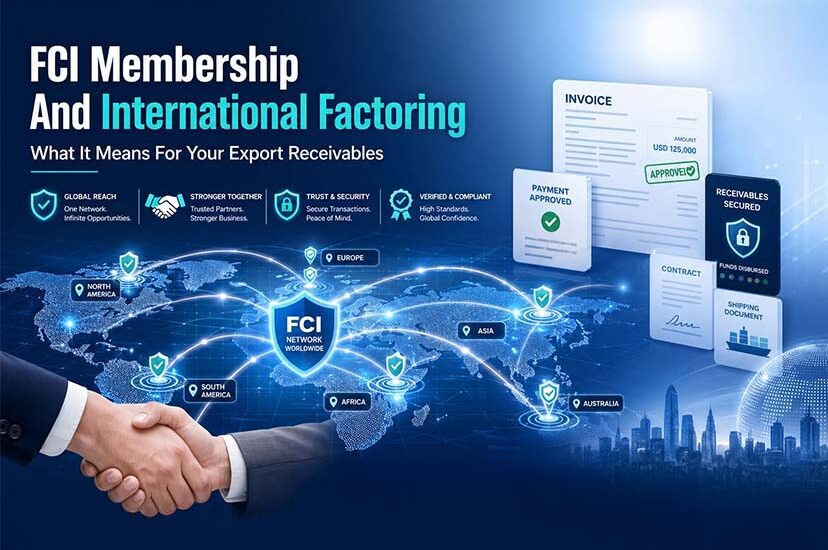
That is where FCI membership and international factoring become closely connected. FCI, formerly known as Factors Chain International, is an international association of factoring firms enabling the cross-border factoring transactions to be standardized and safe. To exporters, collaboration with an FCI-related factor can enhance receivables financing, minimize payment risk, and facilitate international trade more predictably and easily.
What Is FCI Membership in International Factoring?
FCI membership refers to a factoring company or other financial institution that is a member of the global FCI network, the largest association of factoring and receivables finance. FCI has nearly 400 member companies in over 90 countries and serves a large proportion of the global international correspondent factoring transactions.
FCI offers its members:
- An international network of correspondent factors.
- Unified legal and operational regulations.
- Cross-border communication platforms
- Credit insurance and support in collections.
- Training and industry best practice.
To exporters, this implies increased access to reputable foreign factoring services.
What Is International Factoring?
International factoring is a trade finance product in which exporters sell their unpaid international invoices to a factoring company to receive instant funds. Exporters are given an advance on the value of the invoice instead of waiting until overseas purchasers pay.
In many cases, the factor also provides:
- Buyer credit assessment
- Collection support
- Bad debt protection
- Receivables management
This enhances the cash flow and reduces uncertainty in international commerce.
How FCI Membership Supports International Factoring
The key benefit of FCI international factoring is that it involves two factors: one is an export factor in the country of the seller, and the other is an import factor in the country of the buyer.
The export factor funds and handles the relationship with the exporter. The import factor manages buyer credit evaluation, collection of payments and local assistance in the market of the importer. Since both factors are governed by the legal framework with standard rules of FCI, the process is more secure and efficient. FCI also offers communication and transaction management systems, such as edifactoring.com, between member institutions. This two-factor model assists exporters in trading across borders.
Key Benefits of FCI Membership for Export Receivables
For exporters, dealing with an FCI-connected factor can greatly enhance the management of receivables.
Faster Access to Working Capital
Exporters are able to retrieve money within a short period of time against invoices, rather than having to go through long payment cycles. It assists in keeping a consistent working capital to produce and run operations.
Reduced Cross-Border Credit Risk
The import factor evaluates the creditworthiness of the overseas buyer and might offer credit insurance within the accepted limits. This minimizes the non-payment risk.
Easier International Collections
Gathering payments in the international markets may be challenging. Local import factors manage the collection in the buyer country through the network of FCI.
Standardized Legal Protection
FCI offers General Rules of International Factoring (GRIF) that establish a common legal and operational framework of transactions.
Improved Global Expansion Opportunities
Exporters will be in a position to provide competitive payment rates to foreign consumers without damaging their liquidity.
FCI Membership vs Non-FCI Factoring Arrangements
Not all factoring arrangements offer the same level of reliability and global support.
| Basis | FCI-Connected Factoring | Non-FCI Factoring |
| International network | Strong global presence | Limited |
| Legal framework | Standardized rules | Varies by provider |
| Import factor support | Available | May not be available |
| Collections assistance | Local support | Limited |
| Cross-border communication | Structured platforms | Less streamlined |
This renders FCI factoring services more reliable in handling international receivables.
How Exporters Benefit in Real Business Scenarios
Let’s assume an Indian exporter who is selling to a buyer in Europe on 90-day terms might experience issues with cash flows and may not be sure about receiving money.
In an FCI factoring network, the exporter can:
- Receive immediate funds after delivery.
- Get buyer credit support via the import factor.
- Depend on local collections in Europe.
- Minimize risks of payment default.
This enhances liquidity and confidence in the business. In the absence of this, the exporter can experience slow collection and a working capital deficit.
Who Should Consider FCI-Backed International Factoring?
FCI-backed export factoring is particularly useful for:
- MSME exporters with a long payment cycle.
- Businesses entering new international markets.
- Exporters with open-account payment terms.
- Firms with difficulty in overseas collection.
- Companies interested in minimizing bad debt.
This can be a source of stability as well as scalability for growing exporters.
Important Factors to Evaluate Before Choosing a Factor
Before choosing a factoring partner, exporters ought to evaluate:
- Whether the factor is an FCI member.
- Countries included in their correspondent network.
- Financing percentage offered
- The services of collection and protection were provided.
- Charges applicable
The selection of the appropriate partner may have a great influence on receivables management.
Building Stronger Export Receivables Through Global Factoring Networks
One of the biggest assets of an exporter on the balance sheet is usually export receivables. Their efficient management is key to healthy cash flow and business expansion. With international factoring through FCI-linked institutions, exporters are able to enhance the predictability of their payments, lessen their collection burdens and extend globally with more confidence. In the competitive trade world today, good receivables management is not a financial benefit, but a growth strategy.
Turn Export Receivables into Growth Capital with Credlix
Prolonged foreign payments may cause a deceleration of business and a cash crunch. Credlix assists exporters in realizing working capital by using the unpaid invoices, which allows them to access funds sooner than the buyers.
Credlix assists businesses to improve liquidity, efficiently manage export receivables, and expand at a global scale with confidence using flexible trade finance solutions and quicker processing.
FAQs–
- What is FCI membership in factoring?
Membership of FCI implies that a factoring company belongs to a global network, which promotes international factoring by providing standardized legal and operational systems.
- How does FCI assist exporters in controlling receivables?
FCI facilitates the collaboration between the factors of export and import, providing the financing, buyer credit evaluations, and local collection.
- Can international factoring be helpful to MSME exporters?
Yes, overseas factoring can assist MSMEs to enhance cash flow, decrease payment risk, and optimize long international payment terms.
