
- May 7, 2026
- Posted by: Rishabh Agrawal
- Category: Channel Financing
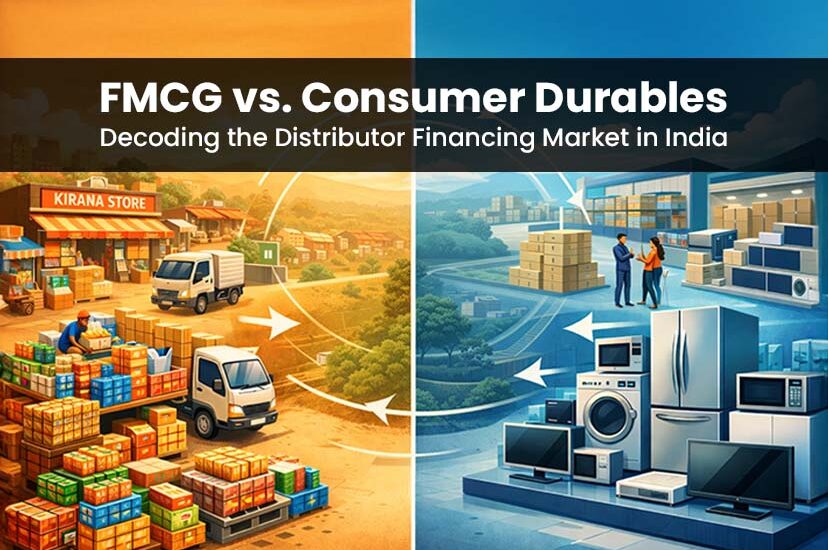
The Indian consumption-driven economy relies on distributor networks to facilitate product movement. Distributors play an important role in ensuring that manufacturers have a steady presence in the marketplace. It could be either through the provision of basic goods or products that have high value. However, maintaining inventory and dealing with credit cycles, as well as operating costs, usually impose economic stress on distributors in different fields.
This is where distributor financing in India comes into play. It allows distributors to get funds to purchase inventory without interfering with cash flow. Although financing needs exist in every industry, the structure, risk profile, and credit requirements differ significantly between fast-moving consumer goods (FMCG) and consumer durables.
The importance of knowing the mechanism of FMCG vs consumer durables financing ensures businesses will be able to create more efficient credit plans. Each segment has different sales cycles, ticket sizes and repayment patterns, and this factor directly determines the structure of distributor financing solutions.
What Is Distributor Financing?
Distributor financing is a form of supply chain financing where distributors are given credit facilities so that they can buy products from manufacturers without paying them all at once. This assists in the stock movement, supports sales growth and aids a smoother operation of the working capital in the distribution networks.
Understanding Distributor Financing in the Indian Market
The distributor financing market in India has developed rapidly, owing to the increased demand for structured working capital solutions. More manufacturers rely on financing partners to support the distribution channels, so that liquidity limits do not affect the supply of products.
In this model, the financial institutions or platforms will give credit to the distributors on the basis of the manufacturer (anchor company) and the transaction history. This minimizes risks to lenders and enhances access to credit by the distributors.
This means that the businesses are able to increase their operations without straining their distributors financially.
FMCG vs Consumer Durables: Key Market Differences
The financing requirements for distributors differ significantly between FMCG and consumer durables because the nature of products, pricing and demand cycles are different.
| Factor | FMCG Sector | Consumer Durable Sector |
| Product type | Daily-use, fast-moving goods | High-value, long-lasting products |
| Ticket size | Low-value transactions | High-value transactions |
| Sales cycle | High frequency | Lower frequency |
| Inventory turnover | Fast-moving inventory | Slower-moving inventory |
| Credit period | Short credit cycles | Longer credit cycles |
These variations define the design of the distributor financing solutions for each sector.
Financing Needs in the FMCG Sector
The FMCG business operates on high volume and rapid turnover. Distributors deal with high-frequency orders and have to maintain stocks at all times to satisfy the existing demand.
Because of this, FMCG distributor financing focuses on:
- Easy access to short-term credit.
- Frequent financing cycles
- Smaller ticket with a large volume of transactions.
- Faster repayment timelines
This segment is dependent on liquidity to ensure the inventory keeps moving. Any delays in financing can destabilize the supply and also affect the sales.
Financing Needs in Consumer Durables
Consumer electronics include expensive products such as appliances, electronics, and equipment. These goods are purchased less frequently, and distributors often deal with larger order sizes.
Consequently, consumer durables financing requires:
- Increased credit limit on high inventory.
- Longer repayment cycles
- Attractive financing arrangements.
- The seasonal demand fluctuations.
As the inventory turnover is also slow, the financing solutions need to provide long payment terms without causing cash strain.
Risk Profile in Distributor Financing
Risk assessment is important in structuring distributor financing in India and varies significantly between FMCG and consumer durables.
The risk in the FMCG sector is low because of:
- High product demand
- Faster inventory turnover
- Shorter credit cycles
Conversely, consumer durables are riskier as:
- Products are expensive
- Sales cycles are longer
- The inventory can take a long time before being sold
Usually, lenders consider the power of the anchor company, performance of the distributors and demand of the market prior to extending credit.
Role of Technology in Distributor Financing
Digital platforms have transformed the way supply chain financing for distributors is delivered in India. The solutions available due to technology allow quicker credit evaluation, automatic approvals, and enhanced tracking of transactions.
Some key advancements include:
- Real-time invoice tracking
- Automated risk assessment
- Digital processes of onboarding
- Accelerated payment schedules
The innovations also ensure that distributors can easily access financing without the complicated paperwork and extended approval process.
Choosing the Right Financing Approach for Each Sector
The distributor financing strategy chosen is based on the nature of the business and the field of operation.
For FMCG businesses, financing solutions must be characterized by speed and flexibility in accordance with the high-frequency transactions. Consumer durables need structured financing, with greater limits and longer repayments.
Manufacturers have to align the financing models according to the needs of the distributors to maintain a constant flow of the product and a stable market position.
Distributor Financing as a Growth Enabler Across Sectors
Distributor financing plays a critical role in supporting supply chain efficiency across both the FMCG and consumer durables industries. Whereas the FMCG segment relies on rapid credit cycles to maintain high sales volume. Consumer durables need systematized funding to cater to larger investment and sales periods.
By tailoring financing solutions to sector-specific needs, businesses can strengthen distributor networks, improve inventory management, and maintain steady market expansion. An effective financing strategy will make sure that the limitation of liquidity will not restrict the growth in various product categories.
Credlix Financing Support for FMCG and Consumer Durable Distribution
The distribution networks usually experience gaps in liquidity in handling inventory acquisitions and credit cycles. Credlix offers trade finance facilities that assist businesses in unlocking working capital in transactions involving supply chains.
Credlix applies with flexible financing models and quicker accessibility of cash, allowing businesses to finance distributors in the FMCG and consumer durables industries, which makes their business operations smoother and establishes a regular supply in the market.
FAQs–
- What is distributor financing in India?
Distributor financing is a supply chain financing option where credit is provided to distributors to allow them to buy goods from manufacturers without immediate payment and continue their inventory flow.
- What is the difference between FMCG financing and consumer durables financing?
The FMCG financing involves lower ticket sizes and shorter repayment periods. The consumer durables financing implies higher credit limits and longer repayment periods, as the values of the products are higher.
- What is the importance of distributor financing to manufacturers?
Distributor financing assists manufacturers in having a consistent stock of their products. It also helps them sustain their distribution systems and enhances overall sales by reducing liquidity constraints for distributors
