
- March 10, 2026
- Posted by: Rishabh Agrawal
- Categories: Export Financing, Blog
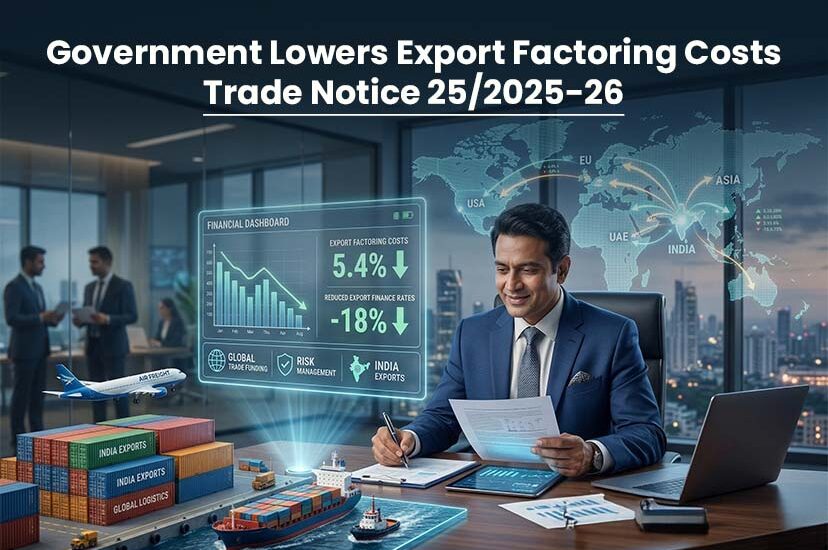
For many MSME exporters, more efficient avenues are available to unlock working capital, thanks to India’s export system being in a structurally stronger phase. Expanding digital trade infrastructure, targeted policy support, and regulated platforms also play a crucial role in this progress. One meaningful step in this direction is the Trade Notice 25/2025-26.
The policy reduces financing costs for exporters by enabling interest subvention on export factoring. Consequently, a wider adoption of receivables-based funding is encouraged. For MSMEs operating in the competitive global market, this is not just an incremental shift. It marks the beginning of a transition from collateral-heavy export finance toward cash-flow-driven, technology-enabled liquidity solutions in the form of export factoring.
This guide gives a comprehensive breakdown of the new directive, exploring how the subvention works, the eligibility criteria, and how MSMEs can claim these benefits. We will also examine how the NIRYAT PROTSAHAN for MSMEs works to strengthen the global competitiveness of Indian exporters.
Understanding the Trade Notice No. 25/2025-26
The Trade Notice No. 25/2025-26, dated 20 February 2026, was issued by the Directorate General of Foreign Trade (DGFT). It is an initiative, Support for Alternative Trade Instruments under the Export Promotion Mission (EPM) – NIRYAT PROTSAHAN, which aims to strengthen access to export finance for MSMEs. It gives structured support for alternative trade finance mechanisms to businesses that are involved in international value chains.
Annexure-I of the notice lays out the complete policy framework, whereas Annexure-III describes the governance structure.
The notice offers several benefits to eligible MSMEs:
- Recourse and non-recourse factoring in INR or freely convertible foreign currency.
- Claim interest subvention at 2.75% on export factoring interest costs under these conditions:
- An annual cap of ₹50 lakh per financial year
- Restricted to a notified positive list of 4,139 HS six-digit tariff lines
A Sub-Committee on Trade Finance will operate the scheme on a pilot basis, and there will also be a dedicated portal where online claims can be filed. The aim is to fill historical gaps in export finance in India.
An Analysis of the Traditional Export Finance Model
Earlier, export finance relied heavily on:
- Packing credit and post-shipment credit
- Collateral-intensive bank lending
- Letter of Credit (LC)-backed financing
- Manual documentation cycles
These traditional instruments helped exporters for years, but they weren’t constraint-free. The problems associated with the traditional model were:
- Elongated working capital cycles
- Uneven access for smaller exporters
- Friction due to the long documentation and approval timelines
- Greater emphasis on balance-sheet-driven than receivables-driven financing
These issues pointed to the need for a more flexible model. The shift can also be attributed to the acceleration of global trade and supply chains becoming further dynamic.
Trade Notice No. 25/2025-26: A New Step on Export Factoring Interest Subvention
Through the Trade Notice No. 25/2025-26, the government has enabled interest subvention benefits related to export factoring for eligible MSMEs.
As a part of the policy:
- MSME exporters get to avail an interest subvention of up to 2.75% on the interest cost component.
- Subvention rates will be determined by the policy guidelines issued from time to time.
- The benefit is applicable to eligible export factoring transactions.
- Eligible factoring entities and financial institutions will be responsible for approving facilities.
Why is Interest Subvention Essential?
Interest subvention is important because it directly improves the effective cost of funds. For example, even if there is a 200-275 basis point reduction, the exporter margins will be boosted dramatically.
This especially stands true for price-sensitive sectors such as:
- Textiles
- Light manufacturing
- Engineering goods
Working Capital Finance Improvement Through Export Factoring
Export factoring essentially changes the financing approach by focusing on receivables for liquidity rather than relying on traditional asset-backed lending.
The export factoring process works as follows:
- MSME exporter creates invoices for the overseas buyers
- The factoring entity makes an evaluation of the receivable
- Funds are released against the invoice
- Collection management happens according to the terms agreed upon
This structural upgrade offers numerous advantages, such as:
- Receivables can be converted into cash faster
- Balance sheets become more efficient
- The dependence on collateral is also reduced
- Alignment with global trade cycles is also enhanced
Eligibility Criteria for Alternative Trade Instruments
Not all MSMEs get the benefits associated with the latest Trade Notice No. 25/2025-26. The eligibility criteria they need to fulfill are:
- Having a valid and active Importer-Exporter Code (IEC)
- Having a valid MSME Udyam Registration Number during the application
- The exports should be listed under the notified positive list of 4,139 tariff lines at the HS six-digit level
It is recommended that exporters get their products verified against Annexure-V of the Trade Notice before they initiate the subvention claim.
How MSME Exporters Can Take Advantage of the New Framework?
Having a structured approach helps the MSME exporters maximize the benefits associated with the evolving ecosystem. For this, the following steps need to be taken:
- Explore Export Factoring Options: Access the regulated platforms to connect with approved factoring entities.
- Assess Receivables Profile: Check the buyer quality, invoice cycles, and export volumes through the International Trade Financing Services Platform or other regulated platforms.
- Evaluate Subvention Eligibility: Confirm whether the interest subvention export factoring benefit is applicable according to the latest policy.
- Use Digital Trade Finance Portals: Use the right platforms to get seamless access to multiple financers.
- Enhance Working Capital Strategy: Plan the cash flow correctly and integrate factoring into the broader treasury.
By following the above-mentioned steps, exporters will be able to capture the full economic benefit of the reforms.
The Macroeconomic Impact of the New Policy: India’s Export Competitiveness Reaches New Highs
The policy’s benefits also extend to the systemic level. This is evident in the fact that it supports:
- Improvement of MSME liquidity cycles
- Reduction in working capital stress
- Enhancement of credit penetration
- Better formalization of export finance
- Strengthening export competitiveness
As receivables-based financing becomes more popular, the export ecosystem in the country will become better adapted to the global demand cycles.
Credlix: Unlocking Liquidity for MSMEs
As the government streamlines costs through Trade Notice 25/2025-26, having the right partner for seamless, collateral-free export factoring solutions is essential. Credlix supports MSMEs by offering pre-shipment, post-shipment, and domestic financing tailored to specific needs. Credlix enables exporters to unlock up to 95% of their invoice value within the initial 24 to 48 hours. We have digitized the process fully to ensure that every step in the financing process, from application to disbursement, is carried out in a hassle-free manner.
FAQs–
- What is the Trade Notice No. 25/2025-26?
It is a directive by the DGFT that introduces interest subvention for export factoring to lower financing costs and promote receivables-based funding for MSMEs.
- Who can avail the subvention benefit of the policy?
MSME exporters with a valid IEC and Udyam Registration whose products fall under the notified list of 4,139 tariff lines are eligible.
- What is the maximum possible interest subvention according to this policy?
Eligible MSMEs can claim an interest subvention of up to 2.75%, subject to an annual capping of ₹50 lakh per financial year.
