
- May 12, 2026
- Posted by: Rishabh Agrawal
- Categories: Export, Industry, Blog
For Indian MSME exporters, securing international orders is just one part of the business obstacle. The main problem usually arises after the goods have been shipped. A large number of international customers insist on 30, 60 or even 90-day credit terms, which may pose a significant cash flow strain on smaller exporters. Meanwhile, it may be challenging and dangerous to control the payment collection process in a foreign country and to assess the credibility of buyers.
This is where the two-factor system in export factoring comes in handy. It assists exporters in accessing working capital quickly and in minimizing the risk of unpaid or delayed invoices. Exporters no longer need to deal with collections and credit checks independently; instead, a well-organized system incorporates financial institutions from both countries.
Learning the mechanism of the two-factor export factoring system assists Indian MSMEs in increasing liquidity, providing improved payment terms with international purchasers, and increasing exports with greater confidence.
What Is the Two-Factor System in Export Factoring?
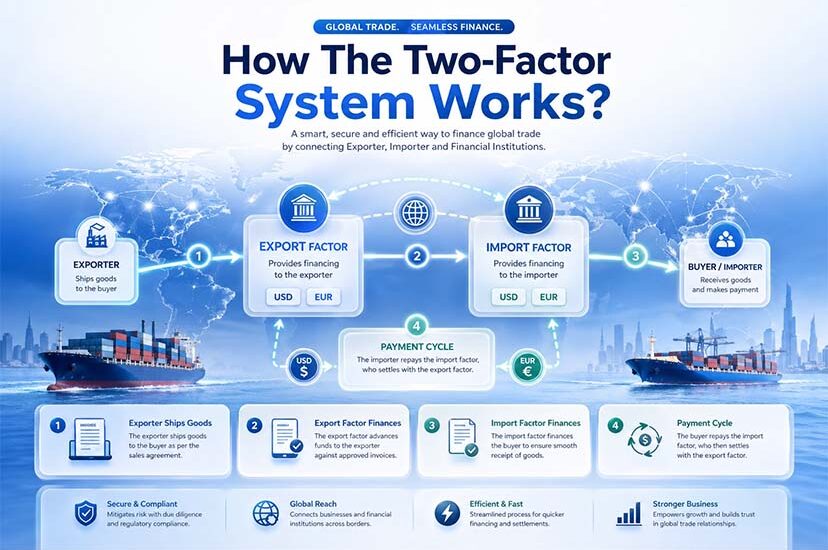
A two-factor system is an international export factoring system that involves two factoring companies: one in the exporter’s country and the other in the importer’s country. The export factor is responsible for financing the seller, and the import factor is in charge of assessing the buyer’s credit, collections, and payment protection.
Why MSME Exporters Face Payment Challenges in Global Trade
Exporting on open-account terms helps Indian businesses remain competitive, but it also puts financial pressure on them. MSMEs usually have limited working capital and cannot afford lengthy wait times before receiving payments.
The most frequent difficulties are:
- Late payment by overseas customers.
- Problem in checking the buyer’s creditworthiness.
- Risk of high collection in foreign markets.
- Cash flow gaps are affecting production cycles.
- Poor access to traditional export finance.
These problems may limit growth during periods of high demand.
How the Two-Factor System Works Step by Step
The two-factor export factoring process has a systematic workflow that assists Indian MSME exporters to obtain earlier payments and lessen the load of collecting and managing overseas collections and credit risks. At every stage, the exporter, the export factor, and the import factor coordinate to facilitate easy financing and recovery of payments.
Step 1: Exporter Ships Goods and Raises Invoice
It starts when the exporter finishes shipping goods or providing the agreed service to the foreign buyer. After the transaction is made, the exporter issues an invoice depending on the agreed credit terms, which can be 30, 60, or 90 days.
Step 2: Invoice Is Assigned to the Export Factor
The exporter then forwards the invoice, shipping documentation, and other supporting paperwork to the export factor in India. The export factor authenticates the paperwork and initiates the factoring arrangement by sending the receivable information to the import factor in the buyer’s country.
Step 3: Import Factor Assesses Buyer Risk
The import factor evaluates the credit profile, payment history, and financial stability before granting a credit limit. The importance of this step is that it will decrease the risk of the exporter to non-payment and provide the exporter with confidence in the transaction.
Step 4: Exporter Receives Advance Payment
After the invoice is accepted, an advance payment is made by the export factor to the exporter. The advance is typically a range of between 70 and 90 per cent of the invoice value and enables the exporter to maintain the cash flow and ensure business operations do not stop until the entire payment cycle is completed.
Step 5: Import Factor Receives Payment
The foreign buyer makes the payment directly to the importer on the due date of the invoice payment. Since the import factor operates in the local market of the buyer, collections are usually more efficient and less problematic.
Step 6: Release of Balance Payment
Once the payment is made to the import factor and the transaction is settled with the export factor, the remaining value of the invoice is discharged to the exporter after factoring in fees and other charges.
The process assists exporters to enhance liquidity, reduce payment risk and manage international trade transactions more effectively.
Key Parties Involved in the Two-Factor System
The success of the international factoring system depends on coordination among various participants
| Party | Role |
| Exorter | Ships merchandise and allocates credit. |
| Importer / Buyer | Buys goods and makes payment. |
| Export Factor | Provide funds and maintain the exporter relationship. |
| Import Factor | Determines the risk of the buyer and collects payment. |
This division of responsibilities brings about efficiency and lessens the uncertainties of payment.
Benefits of the Two-Factor System for Indian MSMEs
There are several useful benefits of the two-factor system for MSME exporters that go beyond faster payments. These advantages can play a great role in terms of sustaining operations among small and medium exporters and ensuring long-term growth.
Quicker Availability of Working Capital
Among the largest benefits of the two-factor system, there is faster access to working capital. Rather than waiting 60 to 90 days to wait before invoices are cleared by overseas buyers, exporters are able to get a big percentage of the invoice amount in advance. This short-term liquidity assists the businesses to cope with the cost of production, suppliers on credit, and accept new orders without causing strain on the cash flow.
Reduced Credit Risk
Selling internationally is usually accompanied by the unpredictability of buyer payment behavior. In the two-factor system, the import factor assesses the creditworthiness of the overseas buyer prior to the transaction being approved. This may also cover payment protection within approved limits in most instances, which will decrease the exporter’s exposure of the exporter to bad debts and late payments.
Easier International Collections
The process of collecting payments made by foreign consumers can be complicated due to differences in language, law, and business practices. Because the import factor is located in the country where the buyer is, it handles collections in that country and is in direct communication with the buyer. This eases the process of collection and lessens the load on the exporter.
Ability to Offer Competitive Credit Terms
When it comes to international trade, buyers prefer suppliers that are willing to provide them with flexible terms of payment. Through the assistance of export factoring, Indian MSMEs will be able to comfortably provide the open-account terms without fearing the immediate problems with liquidity. This makes their business more competitive and assists in attracting bigger or more frequent international orders.
Enhanced concentration on Business Development
Exporters do not need to spend time managing receivables, following up on collections or evaluating the risk associated with buyers, and this helps them concentrate more on business development. The two-factor system enables the companies to focus on growth in new markets, enhance buyer relations and boost export volumes.
Two-Factor System vs Traditional Export Finance
Most MSMEs are used to traditional export loans or packing credit, but these factors differ greatly from factoring.
| Basis | Two-Factor System | Traditional Export Finance |
| Collateral requirement | Usually low or none | Often required |
| Payment protection | In certain cases, it is available. | Limited |
| Collections support | Included | Not included |
| Speed of funding | Faster | Can be slower |
| Based on | Invoice quality and the buyer | Exporter credit profile |
This renders factoring as a viable alternative to growing exporters.
When Should Indian MSMEs Use the Two-Factor System?
The two-factor export finance model is particularly effective when:
- Exporters provide open credit terms.
- The market is unknown to buyers.
- Cycles of payment are long.
- Working capital is tight
- There is a high collection risk.
This system offers liquidity and security to MSMEs that expand into new markets around the world.
Expanding Global Trade with Better Cash Flow Visibility
Scaling export operations requires a stable cash flow. Late payments may interfere with procurement, production, and transportation.
The two-factor factoring model allows exporters to have predictable access to funds and a better visibility of incoming payments. This enables one to plan production cycles and take on larger orders smoothly.
Financial predictability may be equally significant as the identification of new buyers for businesses that want to expand internationally.
Turn Global Receivables into Instant Working Capital with Credlix
Long payment cycles can slow the growth of MSME exports. Credlix provides trade financing services that enable exporters to access working capital based on invoices and enhance cash flow without relying on conventional collateral-based lending.
Credlix, with its increased access to funds and effective financing of receivables, also helps Indian exporters to handle international orders efficiently and venture into international markets with ease.
FAQs–
- What is the two-factor system in export factoring?
It is a global factoring arrangement that has an export factor and an import factor that jointly provide financing, credit protection, and collection support.
- Is the two-factor system suitable for MSME exporters?
Yes. It is particularly helpful to MSMEs with lengthy payment periods and overseas collection risks.
- What is the maximum advance that exporters get under the two-factor system?
Depending on the transaction and the buyer profile, exporters can usually get up to 70 per cent and 90 per cent of the invoice value upfront.
