
- September 15, 2026
- Posted by: Rishabh Agrawal
- Categories: Export Financing, Blog
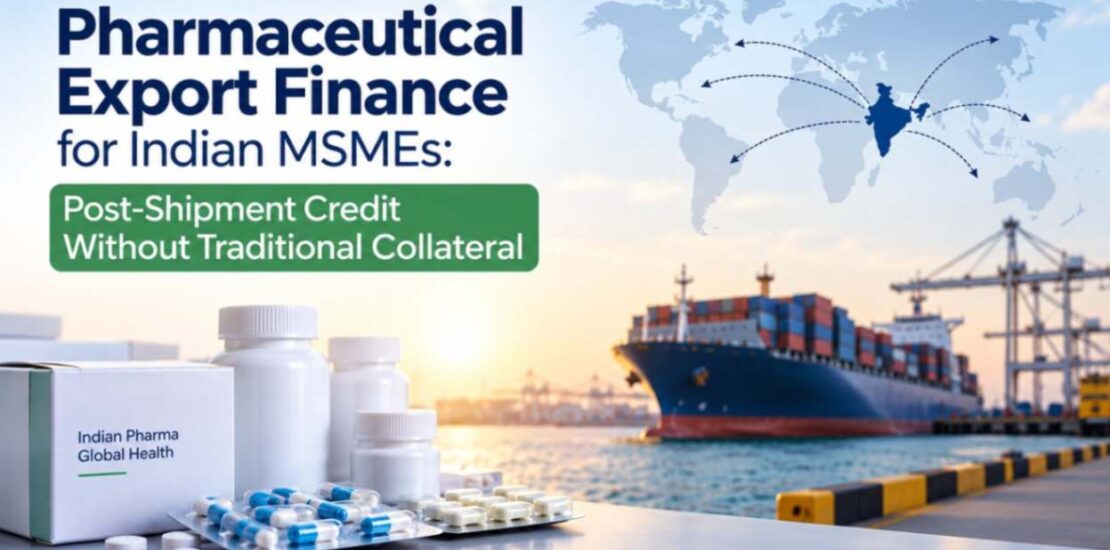
Pharmaceutical MSMEs in India may finish a shipment on time and still wait to receive payment from the overseas buyer after waiting for weeks or months. During that time, the company might need to invest in the next production batch, buy pharmaceutical ingredients, maintain stock of products, pay their suppliers, and fulfill another export order.
That makes pharmaceutical export finance less about financing shipment and more about managing the cash flow gap that arises after the shipment leaves India. Post-shipment credit provides an opportunity for exporters to release liquidity by leveraging export receivables without waiting for the buyer’s payment. Accessing such a loan without putting up further property or other collateral is often the problem for MSMEs.
The financing landscape now includes bank-led export credit, export factoring, and credit-guarantee mechanisms. Understanding these choices can assist pharmaceutical exporters in selecting a structure that will facilitate liquidity and overseas development.
What Is Pharmaceutical Export Finance?
Pharmaceutical export finance offers working capital to the MSMEs of the pharmaceutical sector for eligible export transactions or receivables to cater to the cash flow requirements from the time of shipment till the credit period of the buyer, until the actual payment is received.
Why Pharmaceutical Exporters Face a Longer Working-Capital Cycle
The working-capital pressure in pharmaceutical exports doesn’t stop after the products have left the warehouse.
The production of the APIs, excipients, packaging, testing, quality assurance, batch production, and regulatory documentation could have already involved costs for a manufacturer before the export receivable has been created. If the overseas buyer receives credit terms, the exporter may have to wait even longer for payment. This causes a discrepancy between export receivables and production costs.
An MSME should not constantly have to borrow funds to cover this deficit, as a result of which it is unable to take up bigger orders. It can also lead to reliance on short-term borrowing arrangements which may not be consistent with the real export collection cycle. It is at this stage that post-shipment export financing comes into play.
Post-Shipment Credit Converts Export Receivables Into Liquidity
Post-shipment credit is credit provided after shipment of goods has been made, with the exporter having a receivable from the export transaction.
Depending on the structure, banks can offer finance against export bills or other appropriate export receivables. The underlying documentation of the exports and the terms of payment are important for the lender’s assessment.
For pharmaceutical MSMEs, this can help in filling the gap between shipping out and getting payment without having to wait for the receivable to mature.
The facility can therefore support:
- Purchase of inputs for the next production cycle
- Supplier payments
- Manufacturing and packaging expenses
- New export order execution
- Routine operating expenses
- Liquidity management during longer buyer-credit periods
What Makes Collateral-Free Export Finance Different?
The term collateral-free must not be taken for granted. A credit guarantee can lower the credit risk of the lender and can make it possible to give out more credit without submitting fresh credit security to the scheme of the lender. It does not mean that every pharmaceutical MSME automatically qualifies for unsecured post-shipment credit.
For instance, the government’s credit guarantee scheme for exporters had offered credit facilities of up to ₹20,000 crore with 100% guarantee coverage with the NCGTC for participating lenders. The scheme was launched to support eligible exporters, which included MSMEs, and provided them with an extra credit facility without collateral. It was in operation from December 2025 and was valid until March 2026.
Therefore, exporters should distinguish between:
- A Credit Guarantee: Protection that the lender has under an eligible scheme.
- Collateral-free Lending: Financing where additional collateral is not required under the applicable structure.
- Post-shipment Finance: The underlying export-credit facility provided after shipment.
Export Factoring Can Address the Receivable, Not Just the Loan
Export factoring can be an alternative solution in managing export receivables for pharmaceutical MSMEs doing repeated overseas sales. Currently, ECGC has an export factoring facility for MSMEs. Its published description includes working-capital funding, credit-risk protection, sales-ledger maintenance, and the collection of export receivables. The conditions of a facility are also described in the factoring material of ECGC, under which eligible export receivables can be sold on a non-recourse basis.
For companies that do credit sales on a regular basis, this difference is important. An exporter can consider whether every invoice is a separate borrowing need or if a factoring structure would be the better answer to a more comprehensive view of her export receivables management.
Choosing Between Bank Credit and Export Factoring
The right export financing for an MSME will depend on the nature of the business, instead of just about the availability of a product;
| Requirement | Post-Shipment Bank Credit | Export Factoring |
| Primary focus | Financing eligible export receivables | Financing and managing export receivables |
| Structure | Credit facility | Receivables-based arrangement |
| Buyer assessment | Important | Important |
| Collection support | Usually remains with exporter/bank structure | May include collection services |
| Credit-risk protection | Depends on facility and insurance/guarantee | Can be incorporated in eligible factoring structures |
| Best suited for | Exporters with established banking arrangements | Businesses with recurring credit sales and receivables |
Credlix: Financing Built Around the Exporter’s Cash Cycle
As MSMEs in the pharmaceutical sector grow, they may also be challenged with financing this growth. More orders for exports can result in a higher production volume now but not be paid for until the credit period agreed to by the overseas buyer has passed.
Credlix is able to assess trade finance in relation to these working-capital needs and to offer financing solutions based on the transaction and the cash flow cycle. The goal is to keep exporters’ liquidity flowing smoothly and avoid having their delayed receivables block their ability to accept their next order. It can make working-capital planning a strategic ingredient in the international growth of a pharmaceutical business with several buyers and export markets.
Strengthening Cash Flow Beyond the Shipment
The post-shipment credit for Indian Pharmaceutical MSMEs can help unlock the liquidity of outstanding export receivables, thereby easing the pressure on the cash flow caused by long buyer payment cycles.
Where a valid credit-guarantee structure exists, the exporter might be able to use collateral-free financing; however, it is important to note that not all post-shipment facilities are automatically offered collateral-free.
A more practical way to assess bank export credit, export factoring, credit guarantees, and other export financing solutions for pharmaceutical export finance is to consider their buyer risk, cycle of receivables, documentation, and growth plans.
Frequently Asked Questions
What is post-shipment credit for pharmaceutical exporters?
Post-shipment credit provides financing after an export shipment has been made, allowing an eligible pharmaceutical exporter to access liquidity against export receivables before the overseas buyer pays. It can assist in financing the next production cycle, customers’ credit obligations, and other export working capital needs within the agreed buyer’s credit period.
Can pharmaceutical MSMEs get collateral-free export finance?
The MSMEs can avail collateral-free financing for export transactions if a lender provides a facility that is available to them under any credit-guarantee structure that is applicable. But just because it is collateral-free doesn’t mean it is automatic. As to post-shipment credit, the lender may still consider the exporter’s, buyer’s, transaction’s, documentation’s, repayment capacity, and other considerations that apply to the exporter’s eligibility.
Is export factoring useful for pharmaceutical MSMEs?
Pharma MSMEs that frequently sell their products to international customers with credit terms can find export factoring to be a beneficial solution. Factoring can be a mix of receivables financing with collection and credit-risk support depending on the structure. It can therefore complement the traditional model of export finance when companies prefer to deal with a constant flow of receivables, rather than financing each shipment separately.
