
- September 18, 2026
- Posted by: Rishabh Agrawal
- Categories: Export Financing, Blog
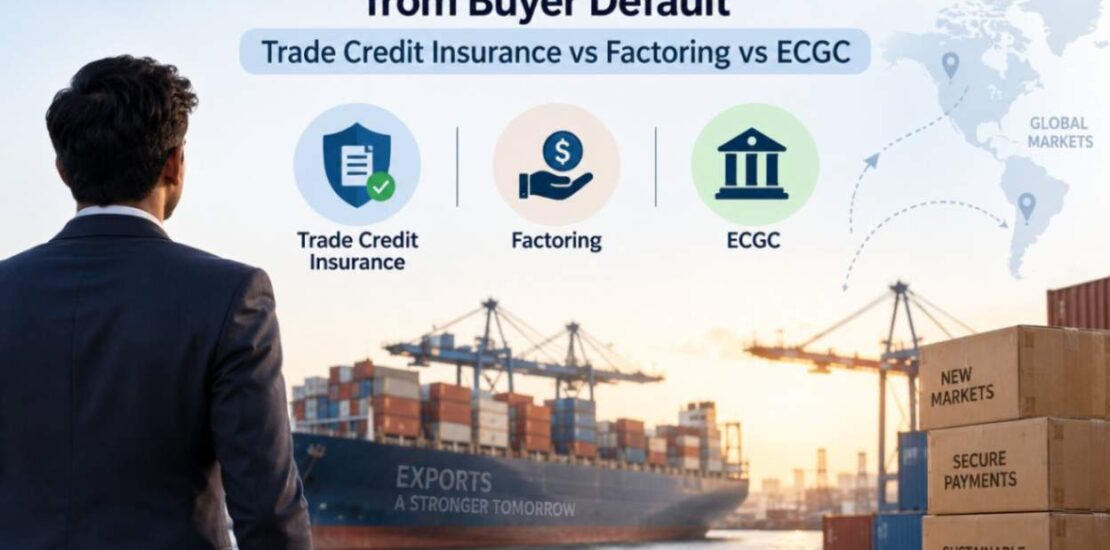
Selling to overseas buyers on credit can help Indian exporters build stronger customer relationships and compete in international markets. However, it also exposes exporters to risks when buyers delay payment, go bankrupt, or fail to pay an outstanding invoice.
There are three options for dealing with this risk: first, take trade credit insurance; second, opt for factoring; and third, avail export credit protection from ECGC. All three are related to export receivables and payment risk, but are used for different purposes. Insurance will be applicable to well-defined risks, factoring can provide liquidity on eligible receivables, and ECGC offers export credit insurance facilities and factoring facilities for eligible exporters.
Understanding these differences can help exporters choose the right combination of protection and working-capital support.
Understanding Trade Credit Insurance, Factoring, and ECGC
Trade credit insurance protects exporters against covered losses caused by buyer non-payment, subject to policy terms and conditions.
Factoring allows exporters to obtain financing against eligible receivables, helping convert outstanding invoices into working capital before buyers make payment.
ECGC is India’s export credit agency, providing export credit insurance and related facilities that protect eligible exporters and financial institutions against specified commercial and political risks.
Why Buyer Default Can Disrupt Export Cash Flow
An unpaid export invoice is more than a reduction in expected revenues. It can tie up the exporter’s working capital when the exporter needs to spend the money on production, raw materials, salaries, transportation, and acquisition of orders.
The risk increases when an exporter extends credit terms or relies on a few foreign customers. One big default can have an impact on liquidity throughout the enterprise. Buyer default protection isn’t just about getting your money back when something goes wrong. It can be part of an overall credit management strategy to help exporters assess the buyer’s exposure and mitigate the financial consequences of missed or covered non-payments.
But not all unpaid invoices are covered by insurance. Before extending credit, exporters must be aware of approved buyer limits, policy conditions, exclusions, reporting, and claim procedures.
Trade Credit Insurance: Protection Against Buyer Non-Payment
Trade credit insurance for exporters is primarily a risk-management tool. The exporter pays a premium from the exporter for the coverage of these credit risks, and the insurer agrees to cover such losses according to the insured policy.
Covered risks can vary from one policy to another and may include commercial risks like buyer solvency and protracted default. There are also specific political risks that can be included in some export credit policies.
There can be a lot of variation in the structure. Cover can be structured over a portfolio of buyers, for specific buyers, or specific transactions. There may be restrictions on the amount of coverage provided to each buyer.
The major advantage for Indian exporters is the risk transfer. The exporter may pass on some of the financial burden of an eligible buyer default to the insurance company under the policy’s terms and conditions.
Factoring: Turning Export Receivables Into Working Capital
Factoring for exporters addresses a different problem. Factoring doesn’t just prevent the exporter from facing a non-payment situation, but it can also provide the exporter with liquidity for the receivables that have already been earned but haven’t yet been received from the buyer.
Under an export factoring arrangement, a factor may buy and finance eligible export receivables and may give financing against them. Depending on the structure, the factor may also undertake receivables collection and credit-risk functions. This makes export factoring particularly relevant when the exporter has genuine sales but faces a cash-flow gap because buyers have extended payment terms.
The exporter might be able to utilize the released funds for production, supplier payments, inventory purchases, and then shipments. Advances, eligibility for buyers, recourse, and costs vary from provider to provider.
The key difference is crucial: factoring is closely associated with the financing and management of receivables, while trade credit insurance is primarily to cover defined credit losses.
ECGC: Export Credit Protection for Indian Exporters
ECGC Limited provides export credit insurance and other related services to exporters and banks in India. It offers policies covering commercial and political export deals. For instance, ECGC has a Specific Buyers Policy in respect of commercial and political risks for eligible shipments to selected buyers.
ECGC also has an Export Factoring Facility for eligible MSME exporters. The facility comprises working-capital financing, credit-risk protection, maintenance of sales ledger, and collection of export receivables, says ECGC. The structure under which ECGC purchases export receivables is non-recourse, with the credit risk of the overseas buyer being assumed by ECGC (with eligibility and facility terms).
Which Option Fits Different Exporter Needs?
Exporters should not pick a product simply because of its name; rather, the first step is to consider the risk that the exporter wants to manage. For companies with significant exposure to overseas buyers, export credit insurance could be a security for eligible receivables against identified risks. Export receivables financing can be an attractive option for businesses with long sales cycles, as it provides them with greater liquidity.
Where both risks are significant, a joint strategy can be approached if the structures are suitable and economically viable. Buyer concentration, payment terms, invoice maturity, transaction size, financing cost, insurance premium, documentation, exclusions, and provider eligibility criteria should all be taken into account.
Choosing the Right Protection for Export Receivables
There is no one correct answer for all exporters. Trade credit insurance is focused on covered payment risks, factoring is focused on receivables financing, and ECGC provides specialized export credit insurance factoring options.
The right approach depends on the profile of the exporter’s buyer, cash-flow cycle, level of risk, structure of the transaction, and financing needs. Evaluating all these elements can help to make buyer-risk management a more strategic part of export growth.
Read: Trade Credit Insurance, Meaning, Working, and Benefits
Credlix: Financing Export Receivables When Cash Flow Matters
Protection against buyer default and availability of working capital are two aspects of the receivables management challenge for exporters. Credlix specializes in funding that may assist businesses with liquidity related to eligible receivables. Export receivables financing can offer access to working capital when exports are subject to long payment terms. This can help companies fulfil new orders without depending on their own cash.
Frequently Asked Questions
Is trade credit insurance the same as factoring?
No. Trade credit insurance mainly protects exporters in case of specific losses caused by non-payment by the buyers. For exporting companies, factoring is about financing and managing eligible receivables, with some factoring arrangements also incorporating credit-risk protection. Both solutions address different needs and can be used as complementary elements of receivables management.
Does ECGC protect exporters against buyer default?
Yes, ECGC policies can cover specified commercial/buyer risks under the terms of the policy, approved limits, exclusions, and exporter obligations. For example, ECGC has a Specific Buyers Policy for eligible commercial and political risks for selected buyers. Exporters are required to follow applicable claim, recovery, declaration and reporting requirements.
Which is better for exporters: factoring or trade credit insurance?
The better choice will vary according to the requirement. Trade credit insurance is more specifically directed towards risks of covered buyer payment, and factoring may provide an exporter with liquidity against eligible receivables. Commercial sense will be considered if a business is exposed to credit risk and has a long payment term.
