
- August 19, 2026
- Posted by: Rishabh Agrawal
- Categories: HTS Code, Blog
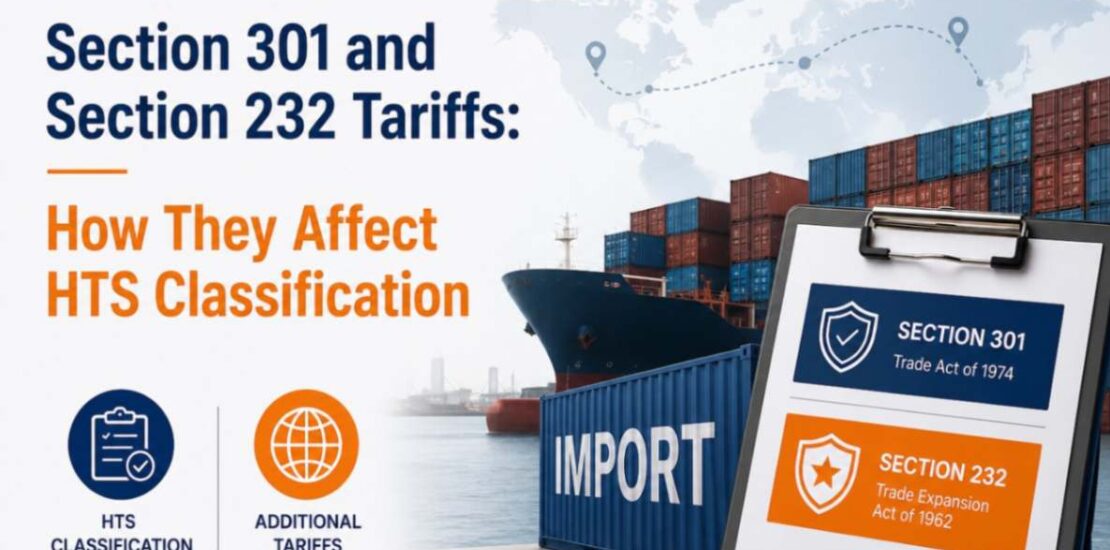
Importers in the United States must consider more than the standard duty rate when importing goods. Some products may also be subject to other obligations arising from trade restrictions, such as Section 301 and Section 232 tariffs. These additional duties are carried out under the provisions of the Harmonised Tariff Schedule of the United States, particularly Chapter 99.
Understanding the tariff is an important aspect for accurate HTS classification. Whether a given tariff measure applies or not may depend on the underlying product classification. However, Section 301 and Section 232 are not a substitute for the normal classification process. The classification is typically made first under the HTS and then evaluated to determine whether additional tariff provisions apply based on factors such as product scope and country of origin.
Explaining Section 301 and Section 232
- Section 301 tariffs are additional U.S. tariffs allowed under Section 301 of the Trade Act of 1974. A series of Section 301 actions have been filed against certain products from China. The applicable products are identified in the provisions of the HTS and related U.S. trade actions.
- Section 232 tariffs are imposed under Section 232 of the Trade Expansion Act of 1962, which covers certain imports relevant to the national security of the United States. Goods that are covered by Section 232 measures are prominent, such as steel and aluminium products. However, the specific products covered are subject to the HTS provisions and other details of the tariff action.
Does Section 301 or Section 232 Change the HTS Classification?
In general, Section 301 and Section 232 do not alter the product classification due to the presence of extra duties.
It is the importer’s responsibility to classify the item on the correct HTSUS classification before applying the General Rules of Interpretation and other classification principles. Classifications start with the HTS and move both through the headings and subordinate provisions.
Once the classification is determined, the importer then needs to check whether the product is subject to an applicable additional duty provision. This distinction is important because an importer should not select an HTS code merely because it produces a preferred tariff outcome.
How HTS Classification Connects With Additional Tariffs
The HTS classification process determines the tariff provision applicable to the merchandise. Additional trade measures may then use HTS provisions to identify covered products.
For example, USITC explains that certain Section 301 duties on Chinese products are provided through Chapter 99 provisions. The relevant Chapter 99 heading works alongside the underlying HTS classification rather than replacing it.
This means importers may need to report both:
- The applicable HTS classification for the merchandise.
- The relevant Chapter 99 provision for an applicable additional duty.
The exact reporting requirements depend on the specific trade measure and current HTS instructions.
How Section 301 Tariffs Affect HTS Classification
Section 301 HTS codes are particularly important for products originating in China because certain additional duties are linked to specified HTS classifications.
The Section 301 actions introduced in 2018 covered thousands of U.S. HTS subheadings. The USITC’s historical overview identifies multiple tranches covering products across technology, machinery, plastics, agriculture, chemicals, textiles, metals, furniture, and other sectors.
However, the fact that a product is manufactured in China does not by itself establish the precise HTS classification. The product must first be classified according to its actual characteristics.
Once the classification is established, the importer can determine whether the relevant Chapter 99 Section 301 provision applies.
How Section 232 Tariffs Affect HTS Classification
Section 232 HTS provisions similarly rely on tariff classifications to identify covered merchandise.
This is particularly relevant for products containing steel or aluminum. However, determining whether Section 232 applies may depend on factors beyond the product’s materials.
The applicable Section 232 action may identify specific products, HTS classifications, countries, quota arrangements, or valuation rules. Certain measures can also distinguish between the value of covered metal content and the value of the complete imported article. Current HTS provisions and applicable CBP guidance must therefore be reviewed for the specific product.
Why Country of Origin Matters
Country of origin can be critical when determining whether an additional tariff applies. Section 301 measures, for example, have historically targeted specified products of China. Section 232 measures may include country-specific provisions, such as tariffs, quotas, or other arrangements, depending on the product and applicable action.
Therefore, an importer should not determine additional tariff liability from the HTS code alone.
A proper assessment may require examining:
- Product classification
- Country of origin
- Product composition
- Applicable Chapter 99 provisions
- Trade remedy exclusions
- Quota or tariff-rate quota provisions
- Current CBP instructions
Section 301 vs Section 232: Key Differences
The table below provides a general comparison. Actual tariff treatment depends on the specific trade action and current HTS provisions.
| Factor | Section 301 | Section 232 |
| Legal authority | Trade Act of 1974 | Trade Expansion Act of 1962 |
| Primary basis | Certain unfair or discriminatory trade practices | National-security considerations |
| Product coverage | Specific products under applicable actions | Specific products and materials under applicable actions |
| Country considerations | Frequently associated with China trade actions | Can involve multiple countries and country-specific measures |
| HTS relationship | Covered products identified through HTS provisions | Covered products identified through applicable HTS provisions |
| Additional duties | Applied in addition to normal duties when applicable | Applied in addition to normal duties when applicable |
What Importers Should Check Before Filing
Accurate tariff classification for imports requires more than identifying a familiar product description. Importers should verify the following before filing an entry:
- Product Characteristics
Review the product’s material, composition, function, construction, dimensions, and intended use.
- HTS Classification
Determine the appropriate HTSUS provision using the applicable classification rules.
- Country of Origin
Confirm the origin under the applicable U.S. customs rules and any relevant trade remedy requirements.
- Chapter 99 Provisions
Check whether a Section 301, Section 232, or other additional-duty provision applies to the transaction.
- Exclusions and Exceptions
Review whether an applicable exclusion, exemption, quota, or other exception affects the additional duty.
- Current HTS Revision
Use the current HTS because tariff provisions can change. The USITC currently publishes updated HTS revisions, including 2026 revisions.
How Credlix Is Supporting Businesses With Trade Finance
Tariff compliance is one part of managing international trade. Importers also need sufficient trade finance to fund inventory purchases and other transaction-related expenses.
Credlix provides digital financing solutions designed to help eligible businesses manage working capital requirements. For businesses involved in international trade, suitable financing can help address liquidity gaps while they manage procurement and payment cycles. Financing does not determine HTS classification or tariff liability.
Read: Trade Finance, Meaning, Working, and Benefits
FAQs
Do Section 301 and Section 232 change the HTS classification of a product?
Generally, additional tariffs do not mean that the underlying HTS classification should be changed. Importers first determine the correct classification based on the merchandise and applicable classification rules. They then determine whether an additional Chapter 99 provision applies. The specific reporting treatment depends on the applicable Section 301 or Section 232 measure.
Can one product be subject to both Section 301 and Section 232 tariffs?
Potentially, yes. A product can fall within the scope of more than one trade measure when the applicable requirements are satisfied. The precise treatment depends on the product’s HTS classification, country of origin, composition, and the provisions governing each tariff action. Importers should review the current HTS and applicable CBP guidance before determining the duties owed.
Where can importers verify Section 301 and Section 232 tariff provisions?
Importers can review the current HTSUS maintained by the USITC and applicable implementation guidance from CBP. The USITC notes that additional duties, such as Section 301 and Section 232 measures, are reflected in applicable HTS provisions, including Chapter 99. For legally binding classification decisions, importers must rely on CBP rather than the USITC.
Also read: What are HTS Codes and Why Do They Matter in Trade?
