
- June 8, 2026
- Posted by: Rishabh Agrawal
- Categories: Export Financing, Blog
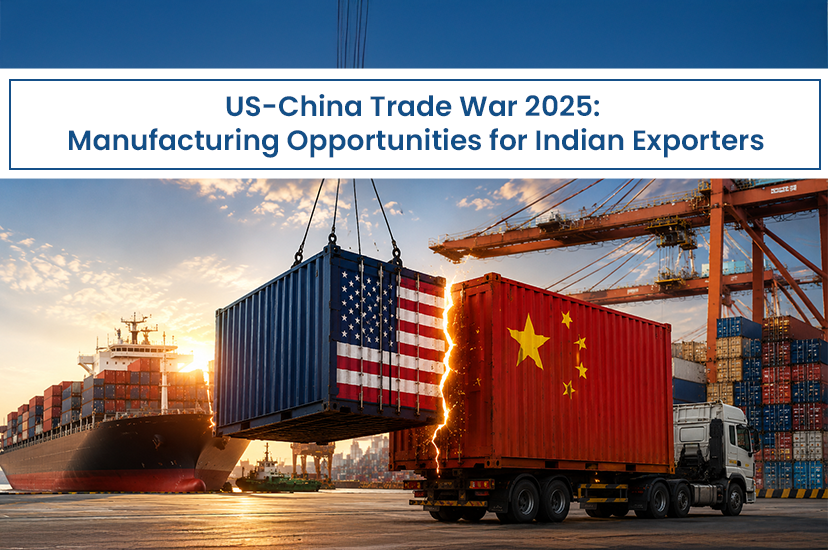
Despite ongoing diversification of supply chains and shifting procurement practices, the US-China trade war remains a key consideration in 2026 for sourcing decisions. Although China is still one of the biggest manufacturing centers, there is growing pressure from multinational buyers to break dependency on the single -country sourcing model. Businesses are diversifying their production among several markets in response to increasing geopolitical uncertainty and risks to supply-chain resilience.
The ongoing manufacturing shift is offering huge possibilities to the Indian exporters in various industries. Modern buyers are looking for alternative sourcing locations that can provide reliability and operational stability. The opportunity for Indian businesses is not just about acquiring export orders but also about gaining a competitive edge in the dynamic global supply chains and achieving sustainable international expansion.
Understanding the Manufacturing Shift
The manufacturing shift refers to the ongoing diversification of global manufacturing networks with businesses moving away from single-country sourcing models. This trend is giving new hope to Indian exporters in various manufacturing industries in the wake of the US and China trade war and changing global supply chains.
The Global Supply Chain Reset Is Still Unfolding
The sourcing shift is not just about moving production entirely out of China. Global companies are adopting a wider China plus one strategy, with China as the primary manufacturing hub and the creation of other manufacturing capabilities overseas. It can be a way for buyers to mitigate concentration risk completely without disrupting existing supplier ecosystems.
Procurement teams are more likely to look at multiple sourcing locations at the same time, due to supply-chain diversification. Many countries are competing for new investment and sourcing opportunities. But the rising industrialization of India, the emergence of export-oriented enterprises, and the enhancement of manufacturing capabilities are helping the nation to become a serious player in modern sourcing strategies.
Why India Is Emerging as a Serious Alternative To China
Here are some of the factors driving India’s growing role within global manufacturing networks–
- Expanding production across key industry sectors.
- Growth of production is supported by a large and skilled workforce.
- Government efforts to promote industrial development.
- Improving logistics and export infrastructure.
- Developing supplier chains within manufacturing clusters.
- Better ties with international trade networks.
The developments are helping to strengthen Indian manufacturing exports from the industries that proactively take part in manufacturing diversification. Despite some issues with infrastructure, compliance, and executing the process consistently, India’s overall manufacturing competitiveness is improving, and more international buyers are looking for alternatives to China.
The Industries Positioned To Gain The Most
These are some of the industries that will stand to benefit from increased export opportunities in the future–
- Electronics and Components
Electronics is one of the biggest export avenues coming out of the manufacturing transition. Buyers around the world are looking to spread out their component sourcing and electronics manufacturing bases to lower their reliance on concentrated production networks. Indian exporters could see increased demand for alternative sourcing partnerships as the electronics supply chain becomes more complex.
- Computer Software and Services
Automotive is moving forward with its increasingly global supplier diversification program. Prospective customers are evaluating manufacturers who can meet complicated production demands and delivery deadlines. This will provide new avenues for Indian precision engineering and automotive supply chain exporters.
- Specialty Chemicals
India is already well established in various specialty chemical markets. In an effort to gain more procurement flexibility, many companies are expanding their base of suppliers beyond production markets. This continues to create inviting opportunities in the chemical manufacturing ecosystems around the world.
- Industrial Manufacturing Inputs
Access to a broad range of machinery parts, industrial materials, fabricated goods, and production inputs is increasingly needed by industrial manufacturers. Reliable and compliance-ready companies with scalable production capacities can be given more procurement opportunities.
The Five Areas Buyers Will Examine Before Shifting Orders
In the manufacturing diversification process, here are five elements that can impact supplier selection–
- Capacity Expansion Requires Investment
Businesses need to demonstrate they can scale up production while maintaining quality and consistency to meet rising export demand. Potential buyers tend to assess whether manufacturers have the capacity to service sustainable exports in the long run.
- Supplier Ecosystems Must Scale Together
Strong manufacturers rely on equally strong supplier networks. When evaluating supporting suppliers, procurement teams frequently consider whether there will be an increase in production capacity in addition to the main manufacturer’s production capacity. Poor supplier systems can lead to weak links along today’s modern global supply chains.
- Compliance Expectations Continue Rising
International buyers are increasingly demanding that suppliers adhere to higher standards of compliance with documentation and operational governance. Companies that have to undertake complex cross-border trade operations need to understand that they will have to face more intense questioning in their sourcing processes.
- Execution Becomes Harder At Higher Volumes
Keeping the business running smoothly while growing is sometimes easier said than done. Buyers verify whether manufacturers can maintain delivery and manufacturing scalability at higher production volumes.
- Liquidity Pressure Builds Before Revenue Arrives
Higher costs involved in procurement and logistics are generally needed in the case of a large order before any payments are received. Strong working capital management and liquidity flexibility are thus important to assess supplier stability over the long-term.
The Window Of Opportunity Will Not Stay Open Forever
The US-China trade war and the overall trend of manufacturing diversification have made a meaningful impact on manufacturing, with a number of industries benefiting from manufacturing opportunities. But such opportunities are being noticed by exporters from around the globe.
The opportunity remains significant for Indian exporters. But competition is becoming increasingly intense. As global sourcing networks evolve, businesses that deepen their operational readiness and increase their export production capacity while also enhancing their overall export competitiveness could be better equipped to establish lasting buyer relationships.
Why Exporters Scaling Manufacturing Capacity Are Turning To Credlix
An issue that often arises for exporters as their manufacturing opportunities grow is that they need capital before revenue. With larger orders, businesses have to spend on procurement, production, inventory, logistics, and supplier coordination before the customers actually pay.
Credlix is addressing this challenge with technology-based trade finance solutions to enhance the flexibility of liquidity and support sustainable growth in exports. The benefits of invoice financing offered by Credlix allow businesses to stay agile when it comes to working capital and operating their business, enabling them to pursue larger export deals and enhance long-term working capital management skills while adapting to changing trade landscapes.
FAQs
- What are the opportunities for Indian exporters in the US-China trade war?
Indian exporters in several manufacturing segments have been given fresh opportunities owing to the diversified sourcing initiatives by many global buyers to minimize the concentration risk.
- What are the top industries to benefit from the manufacturing transition?
Supply-chain diversification is helping several industries. Including electronics, auto parts, engineering products, specialty chemicals, industrial manufacturing feeders, and consumer goods.
- Why is working capital management important during export expansion?
Liquidity management is essential for sustainable growth. It is particularly specific for export volumes to rise, leading to higher procurement, inventory, and production costs before payment is received.
- What steps should exporters take to meet increased demands for their exports?
To enhance the export capacity planning, supplier coordination, compliance readiness, operational execution, and financial flexibility of businesses to support long-term export growth.
