
- August 27, 2026
- Posted by: Rishabh Agrawal
- Categories: Export Financing, Blog
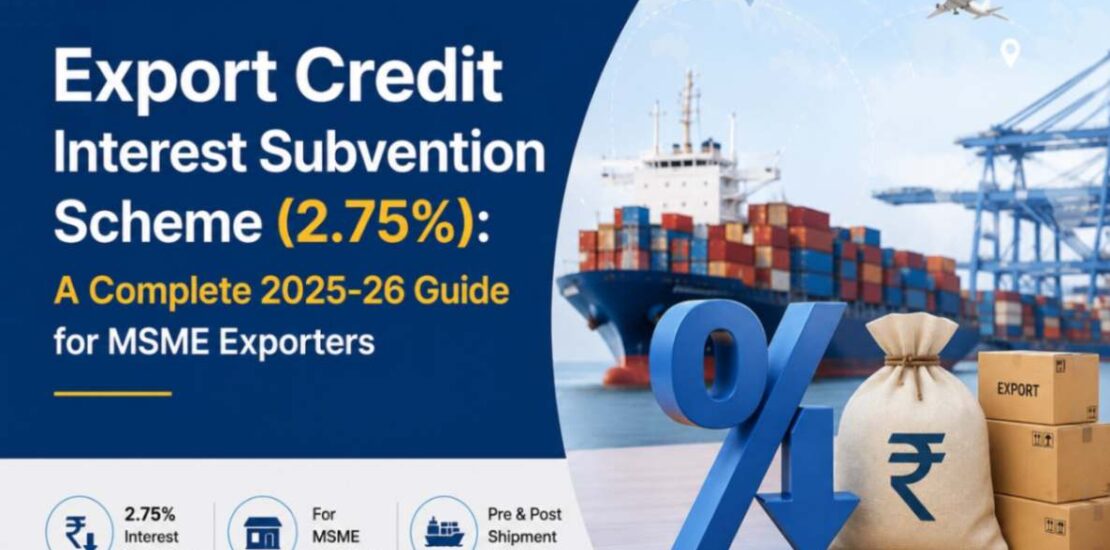
Export credit can have a direct impact on MSME exporters’ margins and cash flow. To reduce the cost of export credit for eligible rupee export credit, the Government of India has sanctioned an export credit interest subvention scheme under the Export Promotion Mission Niryat Protsahan.
The base interest subvention offered to eligible pre-shipment and post-shipment rupee export credit is 2.75% per annum. It has been introduced in DGFT Trade Notice No. 20/2025-26 dated 2nd January 2026 and applies to export credit sanctioned from the date
The annual ceiling for the subvention for FY 2025-26 is not to be prorated but is subject to the conditions of the scheme.
What Is the Export Credit Interest Subvention Scheme?
The export credit interest subvention scheme is an intervention under the Niryat Protsahan sub-scheme of the Export Promotion Mission. It aims to reduce the interest cost on eligible MSME exporters on pre- and post-shipment rupee export credit.
The scheme is implemented through the eligible lending institutions, and the benefit is passed on to the eligible exporters, and the reimbursement is handled through the RBI framework. The support is available to the interest cost incurred by the exporter, within the limits of the applicable guidelines.
This scheme should be separated from previous export interest support schemes. The intervention was initiated in January 2026 within the framework of the Export Promotion Mission.
How Does the 2.75% Interest Subvention Work?
For eligible MSME exporters, support for qualifying pre-shipment and post-shipment export credit is being provided at 2.75% interest subvention.
The benefit is not a blanket 2.75 percentage-point reduction on every form of business borrowing. It applies to eligible export credit and the interest cost covered by the scheme.
For example, if an eligible exporter has ₹1 crore of qualifying export credit outstanding for a period, the theoretical annual subvention at 2.75% would be ₹2.75 lakh for that period if the full amount and period were eligible. The actual benefit depends on the applicable credit, utilisation, interest cost, eligibility conditions, and annual ceiling.
The bank’s commercial lending rate remains subject to applicable regulatory requirements and the subvention is separate from the lender’s underlying pricing.
Also Read: Understanding the Interest Equalisation Scheme for Indian Exporters
Who Can Benefit From the Scheme?
The MSME export finance scheme is intended for eligible Micro, Small, and Medium Enterprises engaged in qualifying exports.
The initial guidelines provide for eligible manufacturer exporters and merchant exporters, subject to requirements including a valid Importer Exporter Code (IEC), Udyam registration, and exports falling within the notified positive list of HSN six-digit tariff lines.
Eligibility should not be determined solely from MSME status. The exporter, export product, credit facility, lending institution, and transaction must satisfy the applicable requirements.
The notified product list is therefore an important part of the eligibility assessment.
What Types of Export Credit Are Covered?
The scheme covers qualifying pre-shipment export credit and post-shipment export credit in Indian rupees.
- Pre-Shipment Export Credit
Pre-shipment export finance supports eligible expenses incurred before goods are shipped. It can help exporters fund activities such as purchasing raw materials, processing goods, manufacturing products, and preparing confirmed export orders.
This type of credit can be particularly important for MSMEs because production costs often arise well before export proceeds are received.
- Post-Shipment Export Credit
Post-shipment export finance supports eligible financing after goods have been shipped. Exporters may need this funding when customers receive credit terms, and payment is completed after delivery.
Together, these facilities can help address different stages of the export working capital cycle.
What Is the Maximum Benefit?
An eligible MSME exporter can receive a maximum interest subvention benefit of ₹50 lakh per financial year, subject to the scheme’s conditions.
For FY 2025-26, DGFT clarified that the annual ceiling applies in full and is not reduced proportionately based on when the facility was sanctioned during the financial year. However, eligible export credit must have been sanctioned on or after January 2, 2026.
The ₹50 lakh figure is a ceiling on the subvention benefit. It does not mean an exporter automatically receives ₹50 lakh.
Which Exports Are Eligible?
The export credit interest benefit is linked to a notified positive list of HSN six-digit tariff lines. Therefore, an MSME cannot determine eligibility only by checking whether it has an active IEC and Udyam registration.
The product being exported must also fall within the applicable notified coverage.
DGFT has subsequently amended the scheme and expanded or refined tariff-line coverage through later notices. For example, Trade Notice No. 01/2026-27 added certain Chapter 72 tariff lines specifically for Micro and Small Enterprises, while excluding Medium Enterprises from that additional coverage.
Exporters should therefore verify the latest applicable HSN list before relying on the benefit.
How Can MSME Exporters Apply?
The MSME export credit scheme operates through the exporter and its lending institution, with DGFT and RBI involved in the broader implementation framework.
Eligible exporters are required to complete the applicable DGFT process for expressing their intent to avail the benefit and obtain the required Unique Identification Number (UIN), which is linked to the relevant lending arrangement.
The exporter needs to coordinate with its lending institution to ensure that the export credit facility, documentation, product classification, and UIN-related requirements are correctly aligned.
The process has also been refined through subsequent DGFT clarifications, so exporters should rely on the latest operational requirements rather than older procedural guidance.
Important Conditions Exporters Should Know
The 2.75% export credit support comes with specific conditions. The facility must qualify under the applicable RBI credit framework. DGFT’s January 2026 amendment also clarified that the benefit relates to the interest cost actually borne by the eligible exporter.
The scheme also contains restrictions around eligible export transactions and account status. For example, support is not available once an eligible loan account is classified as an NPA from the applicable date under the later amendments.
Exporters using multiple lending institutions must also ensure that their total benefit remains within the applicable annual ceiling.
How Credlix Can Support Export Working Capital?
Managing export orders requires liquidity across procurement, production, shipment, and customer collection. Credlix provides financing solutions designed to help eligible businesses manage export working capital and trade-related cash-flow requirements.
For exporters evaluating government-supported credit alongside alternative financing, understanding the underlying transaction and funding requirement is essential. The appropriate financing structure depends on the exporter’s business profile, transaction characteristics, customer relationships, documentation, and applicable eligibility criteria.
Businesses should also distinguish between government interest subvention and the financing product itself. The scheme provides support subject to its rules and it does not replace the lender’s credit assessment or guarantee approval.
FAQs
What is the 2.75% interest subvention for MSME exporters?
The 2.75% interest subvention provides eligible MSME exporters with support on qualifying pre-shipment and post-shipment rupee export credit under the Export Promotion Mission, Niryat Protsahan. The benefit is subject to applicable eligibility conditions, notified export products, lending requirements, and the prescribed annual maximum of ₹50 lakh.
Who is eligible for the Export Credit Interest Subvention Scheme?
Eligible MSME exporters must meet the scheme’s specified conditions, including having a valid IEC and Udyam registration and exporting products covered under the applicable notified HSN tariff lines. The export credit must also meet the prescribed requirements. Eligibility should be verified against the latest DGFT guidelines before claiming the benefit.
What is the maximum interest subvention benefit available?
The export credit interest subvention scheme provides a maximum benefit of ₹50 lakh per eligible exporter per financial year, subject to the scheme’s conditions. For FY 2025-26, DGFT clarified that the annual ceiling is ₹50 lakh. The benefit applies only to qualifying export credit and does not represent a direct ₹50 lakh payment to exporters.
