
- September 17, 2026
- Posted by: Rishabh Agrawal
- Categories: Export Financing, Blog
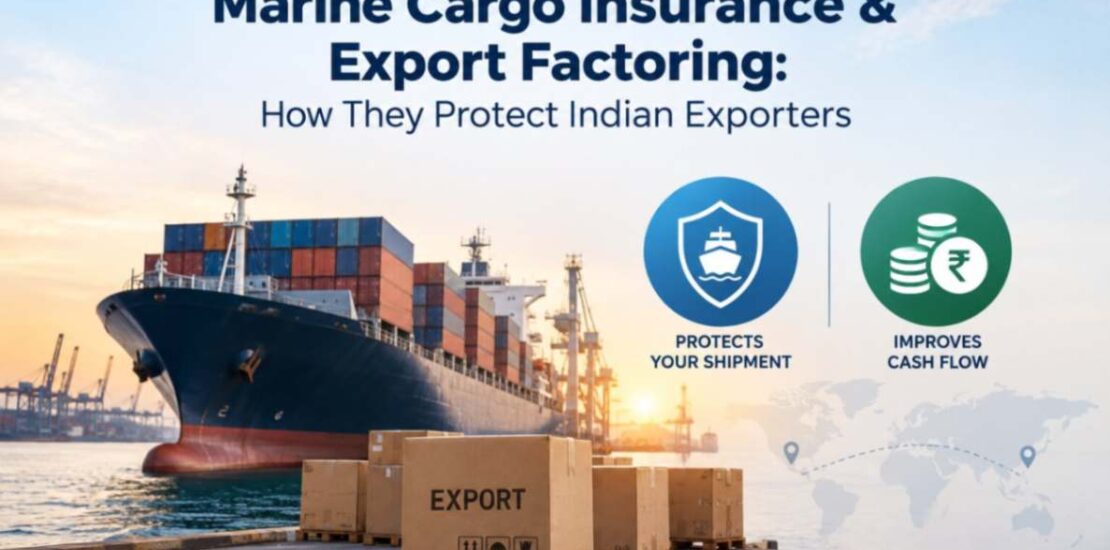
International trade exposes exporters to two very different risks. Goods transported across borders, they can suffer damage, loss or theft, while payment for goods delivered successfully may not be received for weeks or months. For Indian exporters, simultaneously managing these risks is crucial to ensuring cash flow stability and safeguarding the value of each shipment.
Marine cargo insurance is a solution that resolves the first challenge of protecting goods against covered risks during transport. Export factoring deals with the second by providing the business with cash tied up in exportable receivables. They can work together to build export finance resilience throughout the export chain, from dispatch to ultimate payment.
Understanding Marine Cargo Insurance
Marine cargo insurance is used to cover the goods being transported by sea, air, road, rail, or multimodal transportation from a covered loss or damage during transportation. The coverages are dependent upon the policy, insured risks, policy exclusions, and coverage terms.
Why Exporters Need Protection Beyond the Shipment
Once an export order is fulfilled, financial risk doesn’t go away. The risk to an exporter could begin from when goods are put away in the warehouse until the time of receipt by the buyer.
Cargo may be involved in accidents, damaged during handling, stolen, damaged by fire, or subject to other covered events associated with the transportation of cargo. The economic consequence may be more than just the value of the products if a shipment disruption impacts customer obligations or replacement production is required.
The payment risk is another challenge. While goods might be received safely, the exporter may still need to wait for the credit period to elapse before receiving payment. This means that there will be a time lag between spending and earning.
Where businesses have regular international sales, arranging cargo insurance for exporters and ensuring their receivables are dealt with efficiently can help to ensure that an unexpected event or extended collection cycle won’t disrupt the working capital of the business.
Marine Cargo Insurance Protects the Goods in Transit
The aim of marine insurance for exporters is to cover the risks of goods in transit against specified risks. Protection will vary based on the policy. Exporters are advised to carefully examine the covered perils, exclusions, geographical coverage, valuation provisions, deductibles and claims provisions in a policy before relying on it.
Coverage might apply to goods exposed to accidental physical damage, loss of use or theft while in transit or under the insured transit, subject to the policy terms. The mode of transport and type of cargo can also be a factor that may determine the type of insurance agreement to be selected.
The first step for Indian exporters in choosing appropriate coverage is knowing the actual movement of goods. There are different considerations for handling and transit for high-value machinery, auto parts, pharmaceuticals, textiles and other products.
Insurance has no effect on the likelihood of damage to a shipment occurring. Rather, it may reduce the financial consequences of covered losses and provide exporters with greater protection against unexpected events.
Export Factoring Helps Unlock Cash After Shipment
Cargo insurance is designed to cover the shipment, but export factoring covers the part of the export cycle between invoicing and collection. An eligible exporter under a factoring arrangement can assign or sell the qualifying receivables to a factor, subject to the applicable structure and assessment. The factor can advance the money against such receivables so that the exporter can avail the credit in advance of the buyer’s payment due.
This may be beneficial when overseas customers are given credit terms. An exporter can avail the facility to convert eligible receivables into working capital earlier rather than the bills remaining completely tied up till they mature.
Export receivables financing can thus be used to finance such activities as procurement of raw materials, production, payment to suppliers, and readiness for the following orders.
Details of the financing, fees, advance, recourse, and buyer evaluation differ among providers. These are some of the elements to consider when choosing a factoring facility in addition to the underlying transaction.
What Indian Exporters Should Evaluate Before Choosing Both
The right approach depends on the nature of the export transaction and the risks involved. When it comes to marine cargo insurance, exporters should consider the risk covered, transportation route, mode of transportation, claims process, deductibles and exclusions. The policy should be based on the actual movement and characteristics of the goods.
Buyer quality, invoice value, payment terms, receivable ageing, documentation, financing costs, and whether with or without recourse would be key considerations for export factoring in India. Correct commercial invoices, shipping records, contracts and other transaction documents can assist in the administration of insurance and assessment of receivables.
Most importantly, neither solution should be used as a blanket protection for all exporters. The terms of the insurance contract and eligibility of the receivables for factoring determine coverage, and the financing provider’s assessment determines the factoring.
Building Resilience Across the Export Cash-Flow Cycle
Export transactions involve the physical movement of goods as well as the financial movement of money and involve both. Exporters can determine the appropriate cargo insurance for exporters prior to shipment according to the shipping line and the nature of the cargo. After shipment, businesses can track their unpaid bills and may look into export factoring if they have eligible receivables that result in a working capital shortfall.
This approach connects risk and cash-flow planning together on a day-to-day basis. It could be especially applicable to an exporter whose production commitments continue while earlier invoices remain unpaid.
Credlix: Supporting Working Capital After Export Invoicing
Cargo protection is just one of the factors that help ensure financial stability for exporters. Once the goods are delivered and an eligible invoice is raised, access to working capital can become equally as critical.
Credlix enables businesses to consider financing options for their receivables and working-capital needs. Export finance for Indian exporters can finance exports where the payment terms of buyers are extended. The goal is to enable businesses to handle their liquidity more effectively without compromising their ability to service orders and conduct business on their usual collection cycle.
Protecting Both the Shipment and the Cash Flow
International trade does not end when goods leave the warehouse. Exporters need to deal with risks associated with shipping, as well as cash tied up after the invoice is sent. Marine cargo insurance can help you insure covered transit losses, and export factoring can provide liquidity to eligible receivables. Comparing both based on the unique transaction, policy parameters, buyer profile and financing needs can be useful in creating a resilient export operation.
Read: Marine Insurance, Meaning, Benefits, and Working
FAQs
What does marine cargo insurance cover for Indian exporters?
Marine cargo insurance will cover specified risks for goods being exported on an insured voyage, as permitted by the policy’s coverage and exclusions, deductibles and other policy terms and conditions. Protection may be granted in multiple modes of transportation, if applicable by policy. Exporters should check the individual risks and the restrictions to claims as covered by the insurance policy and not assume that all losses are covered.
How does export factoring help exporters manage delayed payments?
Export factoring facilitates eligible exporters to avail liquidity against eligible outstanding receivables, prior to overseas buyers making payment. This can help decrease the strain on working capital resulting from long credit terms. The amount financed, costs, recourse and eligibility are dependent on the factoring provider, the exporter and the underlying buyer receivables.
Can marine cargo insurance and export factoring be used together?
Yes. The different risk areas covered by marine cargo insurance and export factoring can complement each other. The difference between insurance and factoring is that the former is about covered losses or damage to goods in transit, and the latter is about eligible export receivables and cash-flow timing. Neither one nor the other is a replacement for the other, and each carries its own conditions.
